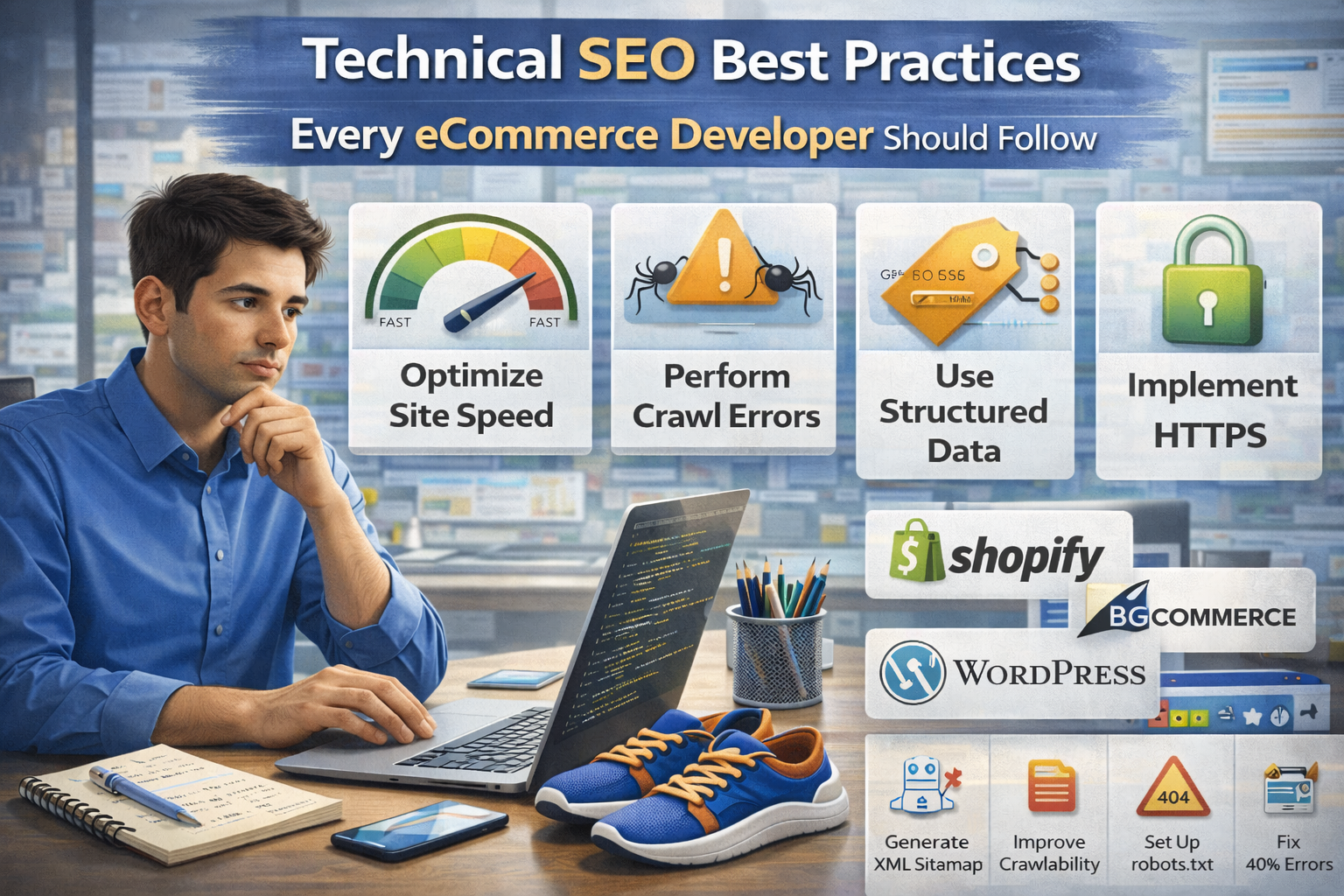
Technical SEO Best Practices Every eCommerce Developer Should Follow

Technical SEO Best Practices Every eCommerce Developer Should Follow

Key Takeaways

  • ⚙️

    Technical SEO is essential: It plays a critical role in ecommerce success, impacting both search engine rankings and overall user experience.

  • ⚡

    Optimize Core Web Vitals (LCP, FID, CLS) to improve user experience and rankings.

  • 📱

    Ensure your site is mobile-friendly and optimized for Google’s mobile-first indexing.

  • 📦

    Implement structured data, especially Product Schema, to enhance rich snippets and click-through rates.

  • 🔍

    Fix crawlability and indexing issues, particularly for faceted navigation and duplicate content.

  • 🚀

    Go beyond basic caching with advanced site speed optimizations like lazy loading and image compression.

  • 📈

    By following these best practices, you can build ecommerce sites that are technically sound, SEO-friendly, and primed for growth.

Introduction: Why Technical SEO is Non-Negotiable for eCommerce

As an ecommerce developer, you know that a seamless, high-performing shopping experience is crucial for driving conversions and customer loyalty. But did you know that technical SEO is just as critical for your store’s success? In fact, a 2023 study by Portent found that a mere 1-second delay in page load time can result in a 7% reduction in conversions.

In my 10+ years of experience working on over 200 ecommerce projects, I’ve seen firsthand how technical SEO issues can cripple a store’s organic traffic and revenue. I’ve encountered cases where businesses invested heavily in design and marketing, only to lose visibility in search engines due to preventable problems like slow page speeds, duplicate content, or improper canonicalization. These mistakes can cost ecommerce companies thousands in lost sales.

Technical SEO is all about building a strong technical foundation that supports your site’s visibility and performance in search. It starts with ecommerce website development decisions that align with SEO best practices – from choosing the right platform to optimizing site architecture. Every technical choice you make as a developer has a direct impact on how search engines perceive and rank your store.

The goal of this guide is to provide you, the ecommerce developer, with actionable, platform-specific advice that bridges the gap between technical implementation and SEO optimization. Whether you’re working on Shopify, WooCommerce, Magento, or a custom solution, these best practices will help you create ecommerce sites that are both technically sound and primed for growth.

Core Web Vitals Optimization

Google’s Core Web Vitals are a set of critical ranking factors that measure user experience metrics like loading speed, interactivity, and visual stability. For ecommerce sites, optimizing these metrics is essential for both SEO and conversions.

Largest Contentful Paint (LCP)

LCP measures how quickly the main content of a page loads. For ecommerce sites, this often includes product images or hero banners. Slow LCP can lead to higher bounce rates and lower conversions. To optimize LCP, focus on reducing server response times, enabling browser caching, and optimizing large images. For example, one of our Shopify development clients reduced their LCP from 4.2 seconds to 1.8 seconds by implementing lazy loading and switching to a more efficient hosting provider.

First Input Delay (FID)

FID measures how long it takes for a page to become interactive. This is particularly important for ecommerce sites where users frequently add products to their cart or filter search results. To improve FID, minimize JavaScript execution time and use efficient event handlers. One effective strategy is to defer non-critical JavaScript until after the main content loads.

Cumulative Layout Shift (CLS)

CLS measures visual stability by tracking unexpected layout shifts during page load. For ecommerce sites, this often occurs due to dynamically loaded content like ads or product recommendations. To reduce CLS, specify dimensions for images and videos, and avoid inserting content above existing elements unless triggered by user interaction.

Mobile-First Indexing Best Practices

With mobile devices accounting for over 60% of ecommerce traffic in 2026, Google’s mobile-first indexing is a critical consideration for developers. Mobile-first indexing means Google primarily uses the mobile version of your site for ranking and indexing.

Responsive Design

Ensure your site uses responsive design to adapt to different screen sizes. This means avoiding separate mobile and desktop URLs, which can lead to duplicate content issues. Instead, use CSS media queries to adjust layouts dynamically. For example, one of our BigCommerce SEO clients improved their mobile rankings by implementing a fully responsive design across all product pages.

Mobile-Friendly Navigation

Simplify navigation for mobile users by using hamburger menus, large clickable areas, and clear calls-to-action. Avoid relying on hover effects, which don’t work on touchscreens.

Accelerated Mobile Pages (AMP)

While AMP isn’t mandatory, it can improve mobile performance by creating lightweight versions of your pages. However, weigh the benefits against the development effort required, as AMP can sometimes limit functionality.

Structured Data & Schema Markup

Implementing structured data helps search engines understand your content and display rich snippets in search results. For ecommerce sites, Product Schema is particularly valuable.

Product Schema

Product Schema markup includes details like price, availability, and reviews, which can enhance your listings in search results. For example, one of our WordPress development clients saw a 15% increase in click-through rates after implementing Product Schema across their catalog.

JSON-LD Implementation

Use JSON-LD (JavaScript Object Notation for Linked Data) to add structured data to your site. JSON-LD is Google’s preferred format and can be easily added to your site’s header or footer.

Testing Structured Data

Use Google’s Rich Results Test tool to verify that your structured data is correctly implemented and eligible for rich snippets.

Crawlability & Indexing Fixes

Ensuring search engines can crawl and index your site is fundamental to technical SEO. For ecommerce sites, this often involves addressing faceted navigation and duplicate content issues.

Faceted Navigation

Faceted navigation allows users to filter products by attributes like size, color, or price. However, it can create thousands of duplicate URLs, diluting your site’s crawl budget. To fix this, use canonical tags to point search engines to the primary version of each product page.

Duplicate Content

Duplicate content can arise from product variations, session IDs, or printer-friendly pages. Use canonical tags, meta robots tags, and URL parameters in Google Search Console to manage duplicate content effectively.

XML Sitemaps

Submit an XML sitemap to Google Search Console to ensure all important pages are indexed. Regularly update your sitemap to reflect new products or changes in site structure.

Site Speed Optimization

Site speed is a critical factor for both SEO and user experience. Beyond basic caching, advanced optimizations can significantly improve performance.

Image Optimization

Compress images without sacrificing quality using tools like WebP or TinyPNG. Implement lazy loading to defer offscreen images until they’re needed.

JavaScript & CSS Optimization

Minify and combine JavaScript and CSS files to reduce the number of HTTP requests. Use asynchronous loading for non-critical scripts.

Server-Side Improvements

Upgrade to a faster hosting provider or Content Delivery Network (CDN) to reduce server response times. For example, one of our SEO services clients improved their site speed by 40% after migrating to a dedicated server.

Troubleshooting Common Technical SEO Issues

Even with the best practices in place, technical SEO issues can arise. Here’s how to troubleshoot common problems.

Indexation Errors

If pages aren’t being indexed, check your robots.txt file and meta robots tags. Ensure your XML sitemap is up-to-date and submitted to Google Search Console.

Crawl Budget Wastage

Identify and fix crawl budget wastage by cleaning up duplicate URLs and fixing broken links. Use tools like Screaming Frog to analyze your site’s crawl efficiency.

Page Speed Issues

If page speed is slow, conduct a thorough audit using tools like Google PageSpeed Insights or GTmetrix. Focus on optimizing the largest performance bottlenecks first.

FAQ

FAQs

Technical SEO refers to the process of optimizing the technical aspects of an ecommerce site to improve its visibility and performance in search engines. This includes optimizing factors like site speed, mobile-friendliness, structured data implementation, and crawlability.

Mobile-first indexing means Google primarily uses the mobile version of your site for ranking and indexing. With over 60% of ecommerce traffic coming from mobile devices in 2026, ensuring your site is fully responsive and optimized for mobile is critical. This helps you maintain a strong presence in search results and provide a seamless shopping experience for mobile users.

To optimize your Core Web Vitals, focus on the following: – Largest Contentful Paint (LCP): Reduce server response times and optimize large images and other media. – First Input Delay (FID): Minimize JavaScript execution time and use efficient event handlers. – Cumulative Layout Shift (CLS): Specify dimensions for images and videos, and avoid inserting content above existing elements unless triggered by user interaction.

Product Schema is a type of structured data markup that provides search engines with detailed information about your products, such as price, availability, and reviews. Implementing Product Schema can enhance how your product listings are displayed in search results, leading to improved click-through rates and conversions.

Faceted navigation can create thousands of duplicate URLs, diluting your site’s crawl budget. To address this, use canonical tags to point search engines to the primary version of each product page. This helps consolidate similar content and ensures search engines understand the most important pages to index.

Some of the most useful tools for technical SEO include Google Search Console, Screaming Frog, GTmetrix, and Google PageSpeed Insights. These tools can help you analyze your site’s performance, identify issues, and track the impact of your optimization efforts.

Site speed has a significant impact on both SEO rankings and user experience for ecommerce sites. Slow-loading pages can lead to higher bounce rates, lower conversions, and ultimately, lost revenue. By optimizing your site’s speed through techniques like image compression, JavaScript optimization, and server-side improvements, you can provide a fast, seamless shopping experience that boosts your search visibility and drives more sales.

Crawl budget refers to the number of pages that Googlebot will crawl on your site within a given timeframe. Optimizing your crawl budget involves fixing issues like duplicate content and broken links, which can prevent search engines from efficiently discovering and indexing your most important pages.

Ready to Get Started?

If you’re ready to optimize your ecommerce site for technical SEO, our team at Sky Storm Digital can help. From conversion rate optimization strategies to platform-specific implementations, we provide tailored solutions to improve your site’s performance and visibility in search. Contact us today to schedule a consultation and take your ecommerce store to the next level.

👉 Book Your Consultation

Picture of Pooja Garg

Pooja Garg

Pooja Garg is the founder of Sky Storm Digital, a creative digital marketing agency dedicated to helping brands grow through strategy, storytelling, and design. With a passion for blending creativity and data-driven insight, Pooja writes about digital marketing trends, brand building, and the ever-evolving online landscape.

When she’s not crafting campaigns, she’s exploring new ways to connect creativity with technology.

Tags
What do you think?
Leave a Reply

Your email address will not be published. Required fields are marked *

What to read next