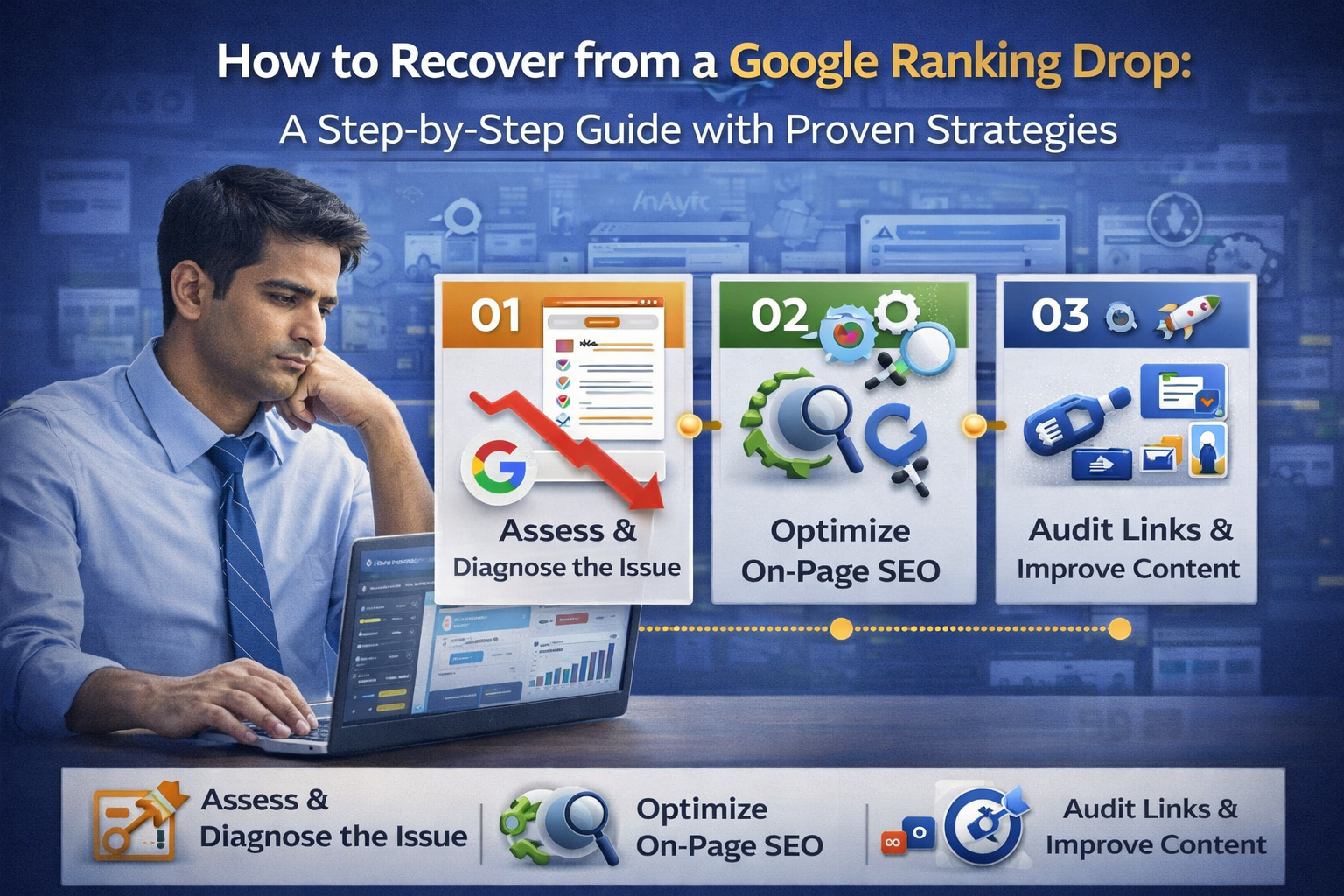
Key Takeaways
-

Google ranking drops are often caused by algorithm updates, technical SEO issues, declining content quality, or poor backlink profiles.
-

Diagnosing issues requires analyzing traffic trends, conducting technical audits, and evaluating content and backlinks carefully.
-

Recovery strategies include fixing technical SEO errors, improving content based on E-E-A-T principles, and strengthening your backlink profile.
-

Stay updated with Google algorithm changes and continuously refine your SEO strategy to maintain rankings.
-

Prevent future drops by consistently monitoring performance and following SEO best practices.
-

Use tools like Google Search Console, SEMrush, and Ahrefs to gain insights and support your recovery efforts.
Experiencing a sudden drop in your Google rankings can be as distressing as losing a major client overnight. It’s that moment when your site’s online presence feels like it’s slipping through your fingers. But take a deep breath, there are practical steps you can take to turn things around. Whether you own a business dependent on organic traffic, manage a website, or work as an SEO professional, understanding how to diagnose and address ranking drops is essential. The goal isn’t just recovery but ensuring your search engine performance comes back stronger.
In this guide, we’re going to walk you through a detailed, step-by-step approach to get back on track. You’ll come to understand the typical culprits behind those discouraging ranking drops, learn how to pinpoint the specific issues plaguing your site, and gather actionable tactics to reclaim lost ground. Additionally, you’ll discover preventative measures aimed at maintaining long-term stability in search engine results. We’ve gathered insights from industry experts and real-world success stories, backed by data from top-tier SEO tools, to provide a comprehensive roadmap to recovery.
What gives this guide its authority? It’s the culmination of over a decade’s worth of expertise from seasoned SEO professionals, reinforced with empirical data and case studies from reliable tools such as Google Search Console, SEMrush, and Ahrefs. Regardless of whether your site was hit by a Google algorithm update, technical issues, or rising competition, this guide aims to empower you with the knowledge to navigate the recovery process confidently.
Understanding Google Ranking Drops
Before diving into strategies for recovery, it’s essential to understand why ranking drops occur in the first place. Google’s search algorithms are famously complex and ever-evolving. So, when your website’s performance suddenly dips, it’s not always the end of the world, it’s an opportunity to refine and enhance your SEO strategy. Typically, ranking drops happen due to reasons such as algorithm updates, technical SEO issues, content quality issues, backlink problems, and increased competition.
Algorithm updates are among the most common reasons. Google is continually refining its algorithms to deliver better, more relevant search results. An interesting fact is that in 2022 alone, Google implemented over 4,000 updates. These updates are designed to weed out low-quality content, which is why they can cause temporary dips as your site is measured against updated criteria.
Technical issues, on the other hand, can directly hurt your visibility. Think about broken links, server errors, or poor mobile optimization, they’re the kind of problems that quietly undermine your efforts. A 2023 SEMrush survey highlighted that about 30% of ranking drops were attributed to technical SEO glitches. Addressing these issues promptly is not just beneficial—it’s crucial.
Then there’s the quality of your content, which is always under the microscope. Google’s E-E-A-T guidelines place significant emphasis on your content’s experience, expertise, authoritativeness, and trustworthiness. If your content doesn’t meet these standards, you might see a drop in rankings. Similarly, a sudden decline in the quality or volume of backlinks can erode your site’s authority, affecting its position on search results pages.
Lastly, don’t underestimate the influence of increased competition. If your rivals are stepping up their game by producing better content or refining their SEO strategies, your rankings might take a hit as Google assesses their relevance relative to yours. Understanding these causes is your first step in the journey of diagnosing and fixing a ranking drop.
Diagnosing the Cause of a Ranking Drop
When it comes to recovering from a ranking drop, the key is in accurately diagnosing the issue—and that starts with data. Begin by scrutinizing your traffic patterns and keyword shifts using reliable tools like Google Search Console, SEMrush, and Ahrefs. You’re looking for sudden changes or gradual declines and trying to pinpoint which keywords took a hit.
Next, let’s delve into the realm of technical SEO audits. An effective audit will uncover lurking issues like broken links, server errors, or suboptimal mobile experiences that could be dragging your site down. Tools like Screaming Frog and Sitebulb are exceptionally proficient at crawling through your site to unearth these technical errors.
After technical audits, it’s time to shine a light on your content. Remember Google’s E-E-A-T? It’s not just a guideline; it’s a mantra. Ask yourself if your content holds up when stacked against your competitors. Is it more engaging and comprehensive? If your answer is no, then updating your content should be high on your to-do list.
Finally, take a hard look at your backlink profile. Use tools like Ahrefs or Moz to sift through your backlinks and identify any spammy or low-quality links. Disavowing these harmful links can be a game-changer, preventing them from tarnishing your site’s authority. By systematically tackling these areas, you’re setting the stage for a robust recovery plan.
Case Study: Recovering from a Ranking Drop
Allow me to share an illustrative story from the trenches. A popular e-commerce website faced a massive ranking drop post-algorithm update. Within a week, their organic traffic nose-dived by 40%, and several top-ranking keywords vanished from the first page. The SEO team rolled up their sleeves and conducted a thorough audit. They discovered multiple red flags—technical errors, faltering content quality, and dwindling backlink quality.
Tackling the issues was a team effort. They patched up broken links, revamped mobile optimization, and refreshed content to align with E-E-A-T standards. A conscious effort was also made to disavow spammy backlinks and fortify their backlink profile with quality links from credible sources. The result? Within three months, the website’s rankings were not only restored but exceeded previous performance, with some keywords climbing higher. This case study underscores the power of a meticulous and systematic approach to troubleshooting and recovery.
Recovery Strategies: Fixing Technical SEO Issues
Technical SEO issues are akin to a leaky faucet; left unchecked, they can cause a lot of damage over time. The first step in remedying these issues is conducting a detailed technical SEO audit. Tools like Screaming Frog or Sitebulb are invaluable for identifying common problems such as broken links, server errors, and mobile optimization shortfalls.
Let’s start with broken links, which can erode your site’s integrity and user experience. By using tools like Screaming Frog, you can identify these culprits and redirect them to functional and relevant pages. Similarly, server errors need to be addressed by ensuring your hosting is dependable and optimizing server response times.
Duplicate content is another typical issue that can stealthily sabotage your rankings. The use of canonical tags can help Google understand which version of a page is the preferred one, mitigating the risks of duplicate content. Optimizing for mobile users is no longer optional; it’s a necessity, considering Google’s mobile-first indexing. Therefore, ensure your site is responsive and loads efficiently on all devices.
Lastly, site speed cannot be overlooked. Utilize tools like Google PageSpeed Insights to pinpoint performance bottlenecks. By compressing images, enabling browser caching, and minifying files, you can enhance load times significantly. Addressing these technical SEO issues not only improves your site’s performance but paves the way for recovering lost rankings.
Optimizing Content Quality
The quality of your content can make or break your site’s rankings. Google’s E-E-A-T guidelines emphasize experience, expertise, authoritativeness, and trustworthiness, which are critical benchmarks for content. To optimize, begin by reviewing your top-performing pages and juxtaposing them with those of your competitors.
Your content needs to be a cut above—informative, engaging, and pertinent to your audience. Update any outdated information, infuse fresh insights, and enhance your content’s readability. Internal linking is also essential; it ties related content together, improving user experience and promoting longer site visits.
Moreover, demonstrating expertise and authority elevates your content’s credibility. Include expert opinions, case studies, and data to fortify your arguments. By optimizing your content quality, you’re not only poised to recover lost rankings but also attract sustained organic traffic.
Auditing and Improving Backlinks
Backlinks act as digital endorsements for your website, underscoring its relevance and authority. However, a dip in backlink quality can lead to a ranking drop. Conducting a comprehensive audit of your backlink profile with tools like Ahrefs or Moz is essential for identifying any low-quality or spammy links. Disavowing these can mitigate their negative impact on your site’s authority.
Next, focus on building high-quality backlinks. Reach out to industry influencers, contribute guest posts to reputable sites, and engage in forums relevant to your niche. By bolstering your backlink profile, you enhance your site’s authority, making it ripe for recovery.
Staying Updated on Algorithm Changes
Google’s algorithm updates are like a moving target, and staying informed is vital for maintaining your rankings. Keeping abreast of these changes involves following industry-leading blogs, attending SEO conferences, and participating in webinars that offer the latest insights and best practices.
Proactively implementing best practices—such as mobile optimization, enhancing site speed, and producing high-quality content—can help you weather these updates. By staying informed and adaptable, you safeguard your site against potential ranking drops and contribute to its long-term stability.
Preventing Future Ranking Drops
To ward off future ranking drops, it’s crucial to routinely monitor and maintain your site’s performance. Conduct regular audits for technical SEO, content quality, and backlink profiles to nip potential issues in the bud before they escalate into significant problems.
Keeping yourself informed about the latest algorithm changes and SEO best practices ensures that your site remains optimized for search engines. By adopting a proactive SEO strategy, you can prevent future ranking drops and foster long-term stability in your search performance.
FAQ
FAQs
Google ranking drops are often caused by algorithm updates, technical SEO issues, declining content quality, and problems with backlinks. Increased competition can also be a factor. Understanding these causes is essential for diagnosing the problem and implementing a recovery strategy.
To diagnose the cause, utilize tools like Google Search Console, SEMrush, and Ahrefs to analyze traffic trends and conduct technical audits. Evaluate your content’s quality and audit your backlinks. These steps are crucial for implementing effective, targeted recovery strategies.
Begin by fixing technical SEO errors and optimizing your content according to E-E-A-T guidelines. Enhance your backlink quality and stay informed about algorithm changes. These strategies collectively will help restore your site’s rankings and recover lost traffic.
Recovery time can vary significantly based on the severity of the issue and the effectiveness of the recovery strategies you deploy. On average, recovery can take anywhere from one to three months, but this can differ depending on the specific circumstances of your site.
Tools such as Google Search Console, SEMrush, Ahrefs, Screaming Frog, and Sitebulb are invaluable for tracking and improving rankings. They provide detailed insights into traffic trends, technical SEO, content quality, and backlinks, essential for a thorough recovery plan.
Google frequently updates its algorithms to improve search results quality. Staying informed about these updates through industry blogs and SEO news outlets can help you understand and mitigate the impact on your rankings.
To prevent future drops, regularly monitor your site’s performance, maintaining high-quality content and diligently managing technical SEO. Staying updated on algorithm changes and adopting a proactive SEO strategy are crucial for long-term stability.
Backlinks are critical for maintaining rankings as they signal your site’s authority and trustworthiness to search engines. A decline in backlink quality can lead to ranking drops, making it essential to audit and improve your backlink profile regularly.
Content quality directly impacts your site’s rankings because of Google’s E-E-A-T guidelines, which prioritize experience, expertise, authority, and trustworthiness. High-quality content is foundational for maintaining and recovering rankings and attracting organic traffic.
Ready to Get Started?
Getting back on track after a Google ranking drop doesn’t have to be daunting. With the right tools and strategies, you can restore your site’s performance and prevent future setbacks. At Sky Storm Digital, our team of seasoned SEO professionals is ready to assist you in diagnosing ranking issues, crafting recovery strategies, and optimizing your site for sustainable success. Contact us today to schedule a consultation and take the first steps towards stabilizing and improving your rankings.


Pooja Garg
Pooja Garg is the founder of Sky Storm Digital, a creative digital marketing agency dedicated to helping brands grow through strategy, storytelling, and design. With a passion for blending creativity and data-driven insight, Pooja writes about digital marketing trends, brand building, and the ever-evolving online landscape.
When she’s not crafting campaigns, she’s exploring new ways to connect creativity with technology.