TL;DR
AI Overviews now appear in 25% of all Google searches, zero-click rates have crossed 60%, and agentic AI is beginning to execute transactions without human involvement. The playbook that drove organic growth in 2023 is producing diminishing returns. This guide covers the nine trends with the most measurable impact on search visibility in 2026, and what the data says you should actually do about each.
The Search Landscape Has Changed More in 18 Months Than in the Previous 5 Years
AI Overviews now appear in 25% of all Google searches, zero-click rates have crossed 60%, and agentic AI is beginning to execute transactions without human involvement. The playbook that drove organic growth in 2023 is producing diminishing returns. This guide covers the nine trends with the most measurable impact on search visibility in 2026, and what the data says you should actually do about each.
Most SEO teams are still optimizing for a search engine that no longer exists in the form they learned it. Google’s AI Overviews, ChatGPT search, Perplexity, and AI Mode have restructured how users get information, and the traffic data is unambiguous about how severe this shift has become.
According to Conductor’s analysis of 21.9 million queries in Q1 2026, 25% of all searches now trigger an AI Overview. Semrush data shows that 43% of those sessions end without any click to an external site. In Google’s AI Mode specifically, that zero-click rate climbs to 93%. When we look across 50+ client accounts over the past 12 months, we’re seeing informational traffic decline significantly even for pages that haven’t dropped in rankings.
The issue is not rankings. The issue is that the destination after the search has changed.
Below are the nine AI SEO trends that have the most real impact on visibility, traffic, and conversions in 2026, along with what the data says you should do about each.
Generative Engine Optimization (GEO) Is Now a Distinct Practice, Not a Repackaged Acronym
What is GEO and how is it different from traditional SEO?
Generative Engine Optimization (GEO) is the practice of structuring content so that AI answer engines such as Google AI Overviews, ChatGPT Search, and Perplexity can find, extract, trust, and cite it in generated responses. Unlike traditional SEO, which optimizes for ranking position, GEO optimizes for citation inclusion, regardless of whether a user ever clicks through to the page.
Our view is that GEO is roughly 80% repackaged SEO with a new acronym. The underlying principles of authority, structured content, and clear answers have always mattered. What has actually changed is the emphasis on three specific elements: entity building, JavaScript rendering, and content structure that breaks information into smaller, extractable chunks.
The market size for GEO services was estimated at $886 million in 2024 and is projected to reach $7.3 billion by 2031, a compound annual growth rate of 34% (Yahoo, 2026). That growth reflects real practitioner demand, not marketing noise.
What to do: Audit your top 20 informational pages for AI citability. Each section should open with a direct, self-contained answer to a question the reader would plausibly ask. If the answer requires reading 300 words of context before arriving at the actual point, it will not be extracted by an AI Overview.
Zero-Click Search Has Crossed the Majority Threshold, and the Trajectory Is Still Upward
How do AI Overviews affect organic click-through rates?
Zero-click search, where a user gets their answer on the SERP without visiting any external website, is no longer a fringe concern. Datos Group and SparkToro data for 2026 confirms that 60% of US Google searches now end on the results page with no outbound click. For queries where an AI Overview appears, the zero-click rate climbs to 83% on average (Click Vision, 2026).
Ahrefs data from late 2025 shows that the presence of an AI Overview reduces organic CTR for position one by up to 58%. Seer Interactive’s measurement found the CTR figure drops from 1.76% to 0.61% when an AI Overview is present. The one counterintuitive finding in the data: brands that are actually cited inside an AI Overview see a 35% CTR lift compared to brands that appear in organic results below the Overview but are not cited within it (Seer Interactive, 2025).
This means the strategic objective has shifted. Ranking below an AI Overview while not being cited inside it is a worse position than not ranking at all for that query, because the user’s intent is fully satisfied before they reach your result.
| Query Type | AI Overview Rate | Avg. Zero-Click Rate |
|---|---|---|
| Informational (how/what/why) | ~57% of question queries | 83% with AI Overview |
| Commercial (best, top, vs) | Growing in 2026 | 43% with AI Overview |
| Transactional (buy, price) | Still low | Similar to pre-AI |
| Google AI Mode (all types) | 100% by definition | 93% |
Agentic AI Is Redefining What 'Optimization' Means for E-Commerce
What is agentic SEO?
Agentic SEO refers to the practice of optimizing digital assets, including product pages, APIs, and structured data feeds, so that AI agents can not only find and cite your brand but execute actions on behalf of users without them ever visiting your site. In 2026, OpenAI’s Agentic Commerce Protocol is operational, and Shopify has enabled one-line checkout integration for AI agents (Search Engine Land, January 2026).
This matters because 63% of ChatGPT agents leave a page immediately after landing on it, and 92% of the time, ChatGPT agents rely on the Bing Search API rather than live page rendering (Search Engine Land, October 2025). If your product data, pricing, and inventory are not accessible in a machine-readable format, you will not participate in the agentic commerce layer at all.
Forrester projects that by 2027, 80% of B2B sales interactions will occur between a buyer’s AI agent and a seller’s digital asset. We’re seeing early signals of this in client accounts that have implemented real-time product feeds, even in 2026.
What to do: Ensure product listings expose pricing, inventory, and shipping data in structured, crawlable formats. Do not block AI crawlers via robots.txt unless there is a specific legal reason to do so. Blocking AI crawlers reduces your citation potential without preventing AI systems from using cached content about you.
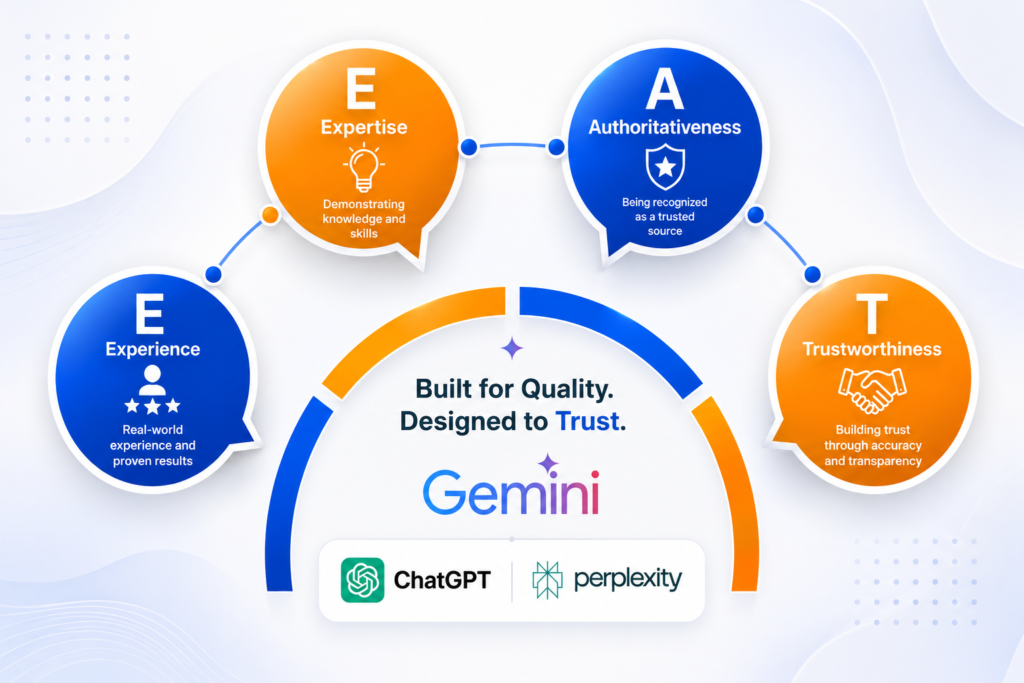
E-E-A-T Has Become the Primary Filter for AI Inclusion, Not Just a Ranking Signal
What does E-E-A-T mean for AI search?
Experience, Expertise, Authoritativeness, and Trustworthiness (E-E-A-T) is Google’s framework for evaluating content quality and source reliability. In 2026, GoodFirms’ survey of practitioners across 20+ countries found that every single respondent agreed trust and credibility signals are becoming more important as AI systems decide which sources to surface. E-E-A-T has moved from a ranking modifier to the primary filter for AI inclusion.
The data on what actually drives AI citations is more nuanced than most E-E-A-T checklists suggest. A study by AirOps (April 2026) found that comparison pages with three or more tables earn 25.7% more ChatGPT citations, validation pages with eight or more list sections earn up to 26.9% more citations, and shortlist pages averaging ten or fewer words per sentence earn 18.8% more citations. Content depth in terms of word and sentence count matters significantly, while traditional backlink counts have minimal impact on AI citation rates.
We’re also seeing that brands are 6.5x more likely to be cited in AI answers through third-party sources than through their own domain (Semrush, April 2026). This validates the investment in digital PR and journalist outreach over volume content production.
What to do: Add real author bylines with verifiable credentials and links to external profiles. Ensure last-updated dates are visible on all editorial content. Add original data, even simple survey results or client analysis, to at least one post per quarter. These are the signals AI systems are actually using to evaluate source reliability.
Brand Authority Has Become the Most Durable SEO Asset in the AI Era
The brands with the strongest AI search visibility in 2026 have one thing in common: they have strong brand signals across multiple platforms, not just strong backlink profiles targeting individual keyword clusters.
Evergreen Media’s analysis from April 2026 found that websites with strong brand presence are significantly more resistant to Google core updates than sites with weak brand signals but strong keyword optimization. According to their data, AI Overviews reduce organic clicks on the top result by an average of 34.5%, but sites with strong branded search volume are buffered against this effect because they receive direct traffic that bypasses the SERP entirely.
YouTube mentions and branded web mentions now have the strongest correlation with AI visibility of any measured signal, ahead of traditional link authority and even content depth (position.digital, 2026). This reflects how LLMs are trained: they absorb content from across the web, and brands with a large, consistent, cross-platform footprint are naturally over-represented in training data and citations.
What to do: Measure branded search volume in Google Search Console monthly. Build email newsletter and direct channels as a hedge against SERP changes. Prioritize digital PR and entity building over guest posting. For link investment, the priority order that produces AI visibility results is: entity building, digital PR, journalist query links, and then guest posts, in that sequence.
Technical SEO Requirements Have Expanded to Include AI Crawler Accessibility
How do you optimize content for ChatGPT and Perplexity?
Technical SEO is getting easier in some respects and more complex in others. HTTPS adoption is now above 91% across analyzed sites, and basic technical standards have improved steadily (Web Almanac, 2025 SEO chapter). But the decisions around AI crawlers, llms.txt implementation, and structured data have added meaningful complexity for technical teams.
A critical finding from Search Engine Land (October 2025): 46% of ChatGPT bot visits begin in reading mode, a stripped version of the page with no images, CSS, JavaScript, or schema markup. This means JavaScript-rendered content that is not server-side rendered is invisible to a significant portion of AI crawler traffic. An OtterlyAI experiment (April 2026) found that AI systems cite HTML pages and do not cite Markdown files, even when the content is identical.
Pages with semantically relevant title tags and URL slugs that match the content topic are more likely to be cited by ChatGPT than pages where these elements are mismatched or generic (Ahrefs, April 2026).
What to do: Audit your top content pages for server-side rendering. Ensure that the content visible in reading mode (no CSS, no JavaScript) is complete and coherent. Validate FAQPage, Article, and HowTo schema on all content pages where these types apply, as FAQPage schema is now specifically cited by AI systems at a growing rate (Search Engine Land, 2026).
Content Structure Has More Impact on AI Citations Than Content Volume
The recurring finding across every AI citation study in 2025 and 2026 is that structure outperforms volume. LLMs parse content linearly and extract information in chunks. Content that is organized into short paragraphs with clear question-format headings, direct answer blocks of 40 to 80 words, and explicit declarative statements is significantly more likely to be cited than long-form content that buries the answer in narrative.
AI and LLM optimization was named as a strategic priority by 43% of respondents in GoodFirms’ 2026 practitioner survey, up from effectively zero as a named discipline a year earlier. Content quality and search intent alignment was named by 54% of respondents as the primary active strategy. The practitioners who are winning are not the ones publishing the most, they are the ones whose content is structured for extraction.
The diagnosis for most sites we audit is consistent: they have a content velocity problem disguised as an AI visibility problem. The volume is high, the structure is weak, and AI systems are bypassing the content because the answer cannot be located within the first two sentences of any given section.
What to do: Convert at least your top 10 informational pages to question-format H2s where the heading asks the question a user would type and the first sentence answers it directly. Eliminate sections that run more than four sentences without a subheading. Add a Key Takeaways section at the top or bottom of each major post.
Multi-Platform Visibility Is Replacing Single-Engine Ranking as the Core Metric
The fragmentation of search across Google AI Overviews, Google AI Mode, ChatGPT Search, Perplexity, Microsoft Copilot, and voice interfaces means that optimizing for one surface is no longer a complete strategy. According to SparkToro’s data, Google processes approximately 14 billion search queries daily while ChatGPT handles around 37.5 million, a ratio of 373:1. But for specific query types, particularly research-heavy and comparison queries, AI platforms have disproportionate influence on brand perception and purchase intent.
Google’s AI Mode reached 75 million daily active users and over 100 million monthly active users by early 2026, representing a 4x increase since its launch in May 2025, and has expanded to 53 languages and over 40 markets (Digital Applied, 2026). Apple’s Siri overhaul in 2026 added another AI-native search surface to monitor.
The practical implication is that citation monitoring across multiple AI platforms has become a required measurement discipline, not an optional experiment. The brands that are building consistent presence across Google, Reddit, LinkedIn, and industry-specific forums are naturally surfaced across more AI answer engines because those platforms feed the training and retrieval data for LLMs.
What to do: Set up monthly monitoring of brand mentions across ChatGPT, Perplexity, and Google AI Overviews using direct queries about your category, not just branded queries. Track which sources are cited when AI systems answer questions about your topic area. That citation pattern is your actual competitive landscape in 2026.
Traditional SEO Remains the Foundation, But the Success Metrics Have Changed
Is traditional SEO still relevant in 2026?
Traditional SEO is still relevant, but the metrics that indicate success have changed materially. The position one organic click-through rate for informational queries has declined significantly with AI Overviews present. But 86.5% of practitioners in GoodFirms’ 2026 survey say ranking number one still matters, with the consistent qualification that this applies primarily to commercial-intent content where users want to compare options, request quotes, or make purchases.
AI isn’t replacing Google. Average Google Search usage actually increased to 12.6 sessions per week among people who also use ChatGPT, according to SparkToro’s research. Users are expanding their search behavior, not consolidating it. The strategic error is treating traffic volume as the only indicator of SEO health. A site can maintain or improve rankings while seeing traffic decline, because the demand for clicks has moved elsewhere in the user journey.
The metrics that actually matter in 2026: branded search volume growth, AI citation frequency across major platforms, commercial intent traffic (the segment least affected by AI Overviews), and direct traffic growth as an indicator of audience relationship strength.
What to do: Do not abandon keyword research and link building. They remain the foundation. But add AI citation tracking, branded search monitoring, and conversion-rate-by-traffic-source to your reporting stack. If clicks from AI platforms convert at 23x the rate of traditional search clicks, as Datos Group and SparkToro data suggests, then a smaller volume of AI-referred traffic may have more revenue impact than a larger volume of traditional organic traffic.
The 9 Trends at a Glance
| Trend | Core Signal | Priority Action |
|---|---|---|
| 1. GEO as distinct practice | GEO market at $886M, growing 34% CAGR | Add direct answer blocks to top pages |
| 2. Zero-click majority | 60% of searches end without a click | Optimize for AI citation, not just rank |
| 3. Agentic AI commerce | 63% of AI agents bounce immediately | Expose structured product data via API |
| 4. E-E-A-T as AI filter | 100% of practitioners cite trust as key | Add author bios, citations, original data |
| 5. Brand authority | 6.5x more citations via third-party sources | Invest in digital PR and entity building |
| 6. AI crawler accessibility | 46% of ChatGPT visits use reading mode | Server-side render, implement schema |
| 7. Structure over volume | Table pages earn 25.7% more citations | Convert H2s to question format |
| 8. Multi-platform visibility | AI Mode at 75M daily users | Monitor citations across platforms |
| 9. Traditional SEO foundation | 86.5% say #1 still matters for commercial | Add AI metrics to reporting stack |
FAQ
FAQs
Traditional SEO optimizes for ranking position in Google’s organic results. Generative Engine Optimization (GEO) optimizes for citation inclusion in AI-generated answers from platforms like Google AI Overviews, ChatGPT, and Perplexity. GEO emphasizes entity richness, direct answer blocks, and content structure over keyword density. In practice, roughly 80% of the underlying work overlaps, with the clearest new requirements being JavaScript rendering, smaller content chunks, and explicit declarative statements that AI systems can extract and cite.
Ahrefs data from late 2025 shows that AI Overviews reduce position one organic CTR by up to 58%. Seer Interactive’s measurement found average CTR dropping from 1.76% to 0.61% when an AI Overview appears. However, brands cited inside an AI Overview see a 35% CTR lift compared to brands ranked organically below it but not cited within it. The implication is that being cited in the Overview is now more valuable than ranking immediately below it.
Yes, but with adjusted priorities. Links still build domain authority, which is a prerequisite for AI citation trust signals. The priority order for link investment that produces results in the current environment is entity building first, digital PR second, journalist query outreach third, and guest posts last. Guest post link quality has degraded significantly, and the impact on AI citations is lower than earned media mentions in authoritative third-party publications.
Content that earns citations in ChatGPT and Perplexity tends to share several measurable characteristics: it is organized in short paragraphs of two to four sentences, uses question-format headings with direct answers in the first one to two sentences following each heading, includes at least three to five citable statistics with source attribution per major section, and is accessible to reading-mode crawlers that strip CSS and JavaScript. AirOps research (April 2026) found that comparison pages with three or more data tables earn 25.7% more ChatGPT citations.
No, but the purpose of informational content has changed. Publishing informational content is now primarily about being cited in AI answers rather than about driving direct click traffic. Content that gets cited in AI Overviews and ChatGPT responses builds brand familiarity before the user’s commercial-intent search, which typically still happens on Google with higher intent to click. The informational-to-commercial funnel still exists, the middle step now often happens inside an AI interface rather than on your page.
Three areas have the clearest impact based on current data. First, server-side rendering: 46% of ChatGPT bot visits use a stripped reading mode that ignores JavaScript, so content rendered client-side is invisible to a significant share of AI crawlers. Second, structured schema markup: FAQPage schema is now specifically associated with higher AI citation rates. Third, clean title tags and URL slugs: Ahrefs (April 2026) found that pages with semantically matching title tags and URL slugs are more likely to be cited by ChatGPT.

Pooja Garg
Pooja Garg is the founder of Sky Storm Digital, a creative digital marketing agency dedicated to helping brands grow through strategy, storytelling, and design. With a passion for blending creativity and data-driven insight, Pooja writes about digital marketing trends, brand building, and the ever-evolving online landscape.
When she’s not crafting campaigns, she’s exploring new ways to connect creativity with technology.