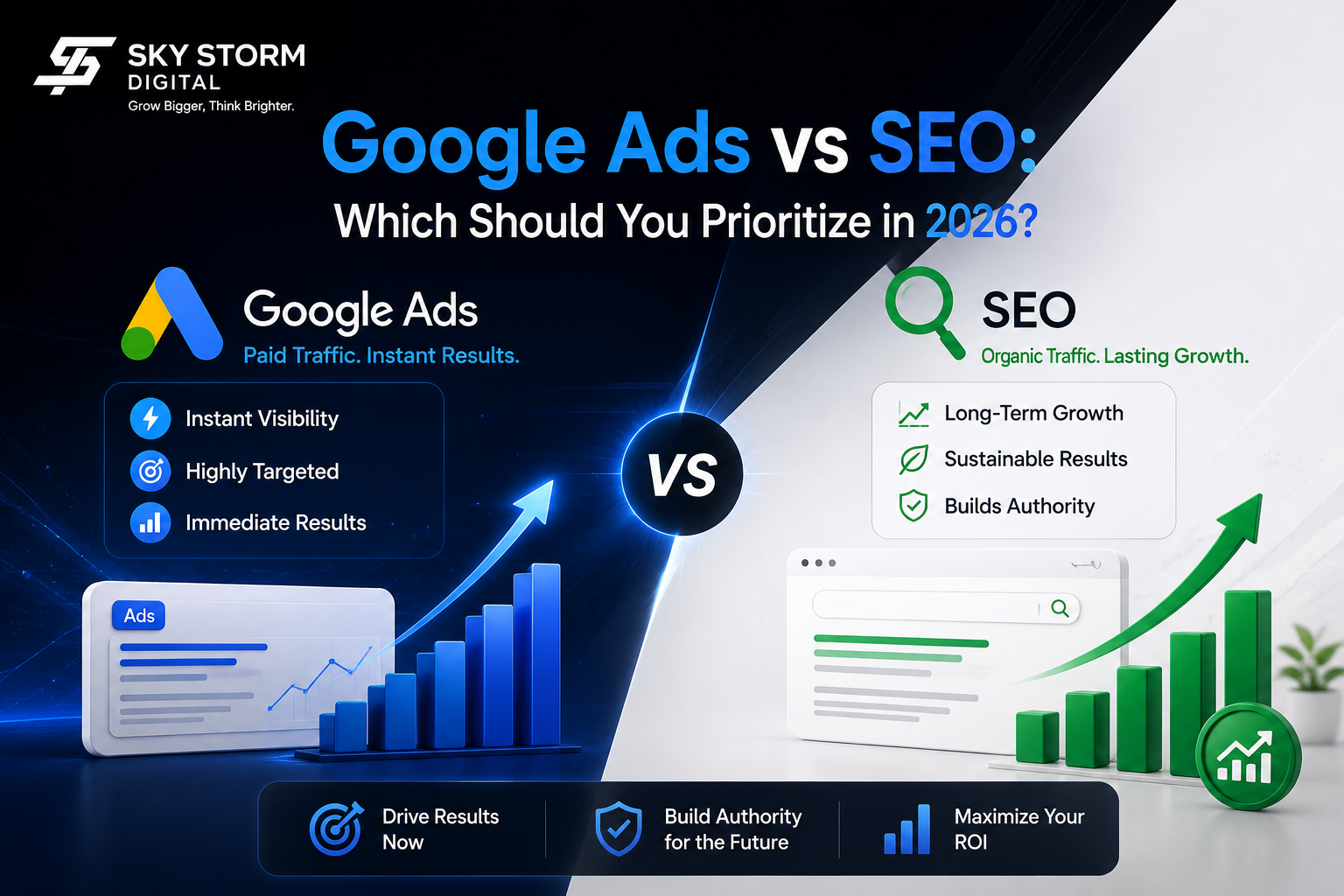
Most business owners who ask us this question are really asking something narrower: where should the next rupee of the marketing budget go so it comes back with a friend. The honest answer is that Google Ads and SEO solve two different timing problems, and the right split depends on how fast you need leads versus how long you want them to keep coming. Paid search buys you traffic today. SEO builds an asset that pays you back for years. Get the sequence wrong and you either burn cash waiting for rankings or rent an audience you could have owned.
Google Ads delivers traffic the day you launch. SEO takes 3 to 6 months to move rankings and 6 to 12 months to turn positive on ROI.
The average Google Search ad now runs about $5.42 per click with an 8.18% conversion rate, though CPCs in India typically sit well below US benchmarks.
Organic leads close at roughly 14.6%, against 1.7% for outbound, because the reader came looking for you.
Paid search click share doubled across major categories in a single year, so ignoring ads entirely leaves high-intent traffic on the table.
For most SMBs the answer is not either/or. Run ads for cash flow now, build SEO for margin later, and let the two feed each other.
Table of Contents
What You Are Actually Buying With Each Channel
Google Ads is a demand-capture machine. Someone types “emergency plumber in Jaipur” and within seconds your ad sits at the top of the page. You pay only when they click, and you can switch the whole thing off at lunch if the phone stops ringing. That control is the product. The catch is that the meter never stops. The moment you pause the campaign, your visibility goes with it.
SEO works the other way around. You are not renting a slot, you are earning one. We spend the first few months on the unglamorous work: fixing technical issues, publishing content that answers real buyer questions, and building the internal links and authority that tell Google you deserve to rank. Nothing much happens for a while. Then the compounding starts, and a page you published in March keeps pulling leads in December without another rupee spent.
Rule of thumb we give clients: if you stopped all marketing tomorrow, paid traffic disappears by dinner. Organic traffic keeps working for months. That difference is the whole argument.
The Numbers, Side By Side
Here is what the current benchmark data shows for each channel. The paid figures come from an analysis of 13,474 campaigns run between April 2025 and March 2026.
| Factor | Google Ads (paid search) | SEO (organic search) |
|---|---|---|
| Time to first results | Same day the campaign goes live | Usually 3 to 6 months before rankings move |
| Cost model | You pay per click, every click, forever | You invest upfront, traffic compounds over time |
| Typical close rate | Solid, but leads cost more to acquire | About 14.6% for organic leads |
| What happens when you stop paying | Traffic drops to zero within hours | Rankings hold for months, then decay slowly |
| Best for | Launches, promotions, high-intent bottom-funnel terms | Durable demand, education, long-term lead flow |
| Control over positioning | Near total, you bid your way to the top | Earned, you compete on relevance and authority |
When Google Ads Should Get The Bigger Slice
Paid search earns the larger budget when speed matters more than efficiency. A few situations where we lean into ads first:
- Launch mode. You have a new product or a new location and zero organic footprint. Ads put you in front of buyers while your SEO is still cooking.
- High-intent commercial terms. Searches like “buy”, “near me”, or “pricing” convert fast. Owning that moment is often worth the click cost even at a premium.
- Seasonal or time-boxed offers. A Diwali sale does not wait six months for rankings. Ads flex up and down on demand.
- Testing demand. Before we commit to a content cluster, we sometimes run a small ad campaign to see which keywords actually convert. Cheaper than guessing.
One caveat worth stating plainly. The average US cost per click sits at $5.42, and paid click share has been climbing fast. A recent study found paid click share doubled across major product categories in a single year while organic clicks fell as much as 23 points in some verticals. Ads are getting more competitive, not less, so a sloppy campaign wastes money quickly.
When SEO Deserves The Priority
SEO wins on math over time. The median return on SEO across industries lands around 748%, which works out to roughly $7.48 back for every $1 spent, and the peak usually arrives in years two and three of the work. You are not paying for each visit, so as traffic grows your cost per lead falls instead of holding flat.
We steer budget toward organic when:
- You sell something people research. Considered purchases, B2B services, healthcare, real estate. Buyers read before they buy, and content earns their trust before the sales call.
- You want leads that close. Organic leads close at 14.6% versus 1.7% for outbound, roughly an 8.6 times difference, because they arrived already looking for a solution.
- Your unit economics are tight. If a paid lead costs more than it earns, you cannot scale on ads alone. Organic lowers blended acquisition cost as it matures.
The SEO ROI figures come from SeoProfy’s analysis, which also pegs the break-even point for most campaigns at 6 to 12 months. That lag is the real cost of SEO. Not the invoice, the wait.
The Split We Actually Recommend
For most small and mid-size businesses the smart move is to run both, weighted by where you are in the journey. Our default play looks like this.
Months 0 to 3: buy your way in
Put the majority of the budget into tightly targeted Google Ads on your highest-intent terms. You need leads now to keep the lights on, and this is the only channel that delivers them on day one. At the same time, start the SEO groundwork so the clock begins ticking.
Months 3 to 9: shift the center of gravity
As organic rankings start to land, pull back paid spend on any keyword where you now rank in the top three. There is no reason to pay for a click you can earn for free. Redirect that money into more content and more link building.
Months 9 and beyond: ads become a scalpel
By now SEO should carry your steady lead flow. Ads shift to a precision tool: new product launches, competitive terms you cannot yet rank for, and remarketing to people who already visited. You spend less on paid and get more from it.
The version we ship for a typical Jaipur SMB starts near 70% paid, 30% SEO, and inverts to roughly 30% paid, 70% SEO within a year. The exact numbers move with your margins, but the direction almost never does.
How to decide this week
If you want a fast gut check, answer three questions. How soon do you need leads, this month or this year? How much can you invest before the return shows up? And is what you sell something people search for repeatedly, or a one-time impulse? Need leads this month with patience for the payoff being thin means start with ads. A longer runway and a research-heavy purchase means weight SEO from the start. Most owners land somewhere in the middle, which is exactly why the blended approach tends to win.
Want to pressure-test your own split? Pull your last 90 days of Google Ads data, look at cost per lead by keyword, and mark every term where you already rank organically on page two or three. Those are the keywords to stop paying for first. Run that same review against your own numbers and the priority order usually sorts itself out.
FAQ
Frequently Asked Questions
Over a single month, ads look cheaper because you see leads immediately. Over a year or two, SEO wins on cost per lead because you stop paying per click. The median SEO return sits near 748% precisely because that traffic keeps arriving after the spending stops. Cheaper depends entirely on your time horizon.
Expect 3 to 6 months for rankings to move meaningfully and 6 to 12 months for the campaign to turn positive on ROI, per current benchmark data. New sites and competitive niches sit at the longer end. This is why we rarely recommend SEO alone for a business that needs leads next week.
You can, and some businesses do, but you are renting your entire pipeline. The day the budget stops, so do the leads. With paid click costs rising and paid click share doubling year over year, that rent gets more expensive over time. SEO is the equity you build alongside the rent.
Yes, more than most owners expect. Running ads on a keyword while you build organic authority for it gives you double coverage on the results page, and the click and conversion data from ads tells you exactly which topics are worth writing about. We use paid data to prioritize the content calendar all the time.
Start with a small, tightly focused ad campaign on your three or four highest-intent keywords to generate cash flow, and put a modest amount into SEO groundwork in parallel. As organic starts to land, move the paid budget off keywords you now rank for. That way today’s leads fund tomorrow’s free traffic.
Conclusion
Google Ads and SEO are not rivals fighting for the same budget. They are two ends of the same timeline. Ads solve for now, SEO solves for later, and the businesses that grow fastest use paid to fund the wait while organic compounds underneath. If you are starting from zero, lead with ads and build SEO in the background. If you already have some organic traction, tilt the budget toward the channel that lowers your cost per lead every month it runs. Either way, the goal is the same: own more of your demand and rent less of it every quarter.

Pooja Garg
Pooja Garg is the founder of Sky Storm Digital, a creative digital marketing agency dedicated to helping brands grow through strategy, storytelling, and design. With a passion for blending creativity and data-driven insight, Pooja writes about digital marketing trends, brand building, and the ever-evolving online landscape.
When she’s not crafting campaigns, she’s exploring new ways to connect creativity with technology.