Key Takeaways
-

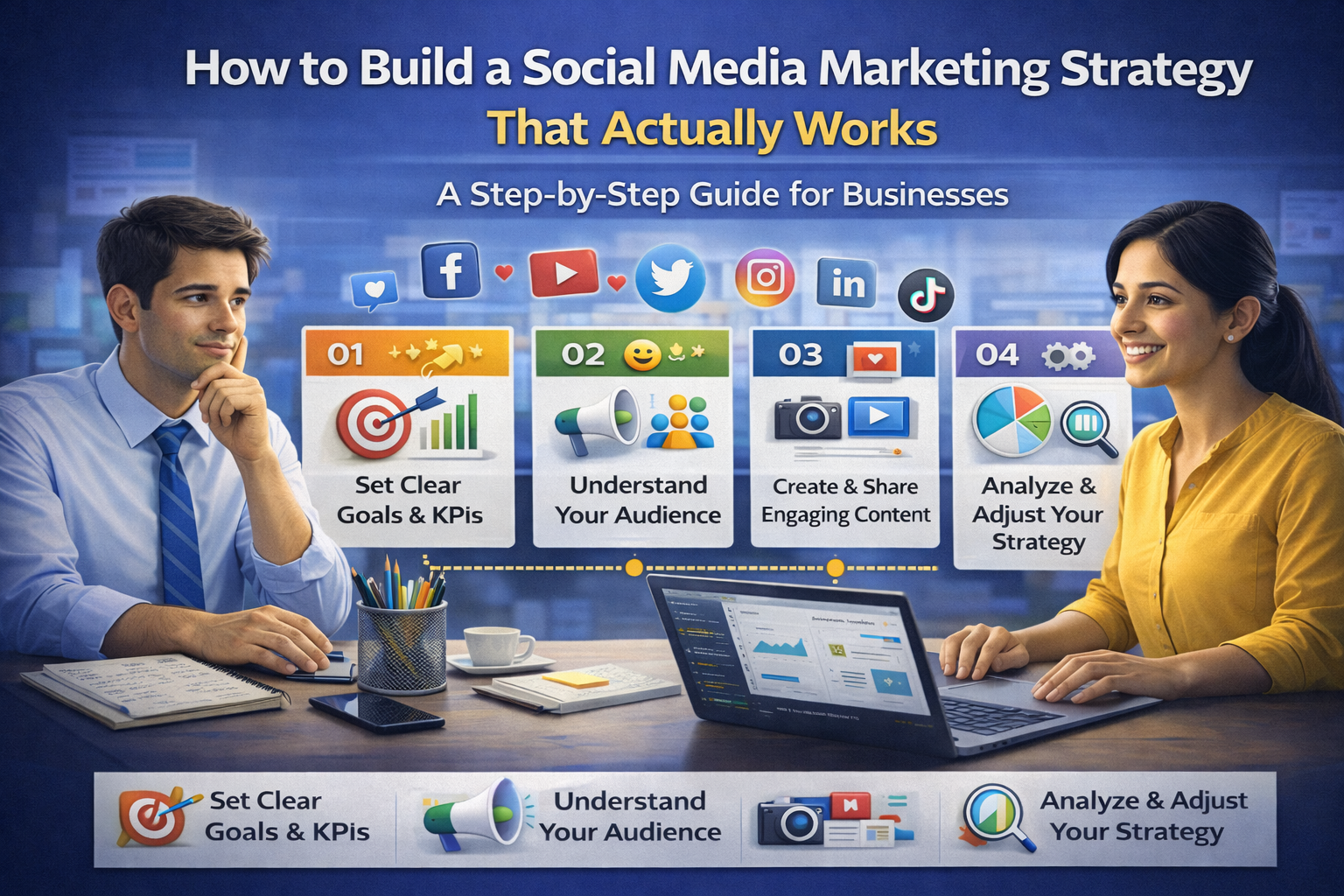
Set SMART goals aligned with your business objectives to ensure your social media efforts are purposeful and measurable.
-

Conduct thorough audience research to understand demographics, preferences, and behaviors, and create detailed buyer personas to guide your strategy.
-

Choose social media platforms that best match your target audience and content style while staying aware of emerging platform trends.
-

Use a content calendar to maintain posting consistency and diversify your content formats for better engagement.
-

Track performance using KPIs such as engagement rates, reach, and conversions to continuously refine your strategy through data-driven insights.
In today’s digital age, social media is a powerhouse for businesses looking to expand their reach, generate leads, and nurture customer relationships. With more than 4.9 billion users worldwide as of 2023, as reported by Statista, the potential reach of social media is unparalleled. However, without a coherent strategy, businesses often flounder, posting content that fails to engage or align with core business objectives. You might have seen this before random posts with no clear goals leading to inconsistent engagement and squandered resources.
As someone who’s navigated the digital marketing landscape for years, We’ve observed that successful social media strategies are anything but random. They are built on a foundation of clear goals and a deep understanding of their audience. Such businesses strategically select a few key platforms, maintain consistent messaging, and evaluate performance rigorously. This guide will take you through the essential steps of crafting a social media marketing strategy that is both real and measurable, ensuring you connect content with audience and business goals effectively.
Whether you’re starting fresh or refining an existing strategy, this guide provides practical insights tailored to your needs from setting SMART goals to platform selection and performance analysis. Let’s dive in and unravel the process of creating a social media strategy that fosters engagement and growth.
Define Clear Objectives and Goals
The cornerstone of any successful social media marketing strategy is having clearly defined goals. Without these objectives, it becomes nearly impossible to measure success or ensure alignment with broader business goals. Here’s the thing—when setting goals, the SMART framework comes into play: Specific, Measurable, Achievable, Relevant, and Time-bound. Instead of vague aspirations like “increase followers,” aim for something like “boost Instagram followers by 20% over the next three months.”
Aligning your goals with your business objectives is crucial. For instance, if your business aims to enhance brand awareness, focus on metrics like reach and impressions. Conversely, if driving website traffic is a priority, keep an eye on click-through rates. For lead generation, monitor conversion rates and lead quality. By connecting social media goals to business outcomes, you ensure your efforts are not just busy work but are contributing to meaningful growth.
In our experience working with businesses, We’ve witnessed remarkable achievements when goals are crystal clear. A client of our, a bustling local bakery, ramped up its Instagram followers by 30% in six months by zeroing in on aesthetically pleasing content coupled with targeted hashtags. Meanwhile, an e-commerce client significantly increased website traffic by utilizing strategic Facebook ads and engaging posts. These stories highlight the power of setting SMART goals aligned with your business strategies.
Align Goals with Business Objectives
It’s essential to ensure your social media goals bolster your overarching business objectives. For instance, if your company is preparing to launch a new product, the strategy might focus on generating buzz and pre-orders. Alternatively, if customer retention is the aim, crafting content that promotes engagement and loyalty—such as exclusive promotions or inside looks at your processes—can be very effective.
Set SMART Goals
SMART goals provide clarity and direction. They help plan with precision while allowing for tracking progress. Goals should be specific to eliminate confusion, measurable to track progress, achievable to avoid setting unrealistic targets, relevant to align with business priorities, and time-bound to create urgency. Applying this framework ensures your strategy is not only purposeful but also driven by tangible results.
Conduct Thorough Audience Research
Understanding your audience is the bedrock of a compelling social media strategy. It starts with demographic analysis—examining age, gender, location, and income levels. Tools such as Facebook Insights and Twitter Analytics offer a treasure trove of data on your audience’s characteristics and interests. A 2022 Pew Research Center study, for example, revealed that platforms like Instagram and TikTok skew younger, whereas Facebook boasts a more diverse age group.
Behavioral insights are no less vital. You need to uncover your audience’s preferences, pain points, and online habits. Tools like Google Analytics and social listening platforms can shed light on the types of content your audience engages with most. For instance, if your audience has a penchant for video content, focusing on platforms like TikTok or Instagram Reels might be strategic. Understanding these nuances helps tailor your strategy to meet audience needs effectively.
Creating audience personas can further refine your strategy. These personas are detailed profiles that reflect your ideal customers, including job titles, hobbies, challenges, and preferred platforms. Consider a persona for a fitness brand: “Emma, a 30-year-old yoga enthusiast who follows wellness influencers on Instagram.” These personas serve as guides for your content creation and platform decisions.
Use Audience Insights Tools
Take advantage of tools like Facebook Audience Insights and Google Analytics to gather actionable data on your audience’s behavior and preferences. This data is invaluable in shaping a content strategy that speaks directly to them.
Create Detailed Personas
Develop detailed personas to represent your target audience, including demographics, interests, pain points, and platform preferences. This information is crucial in crafting content that truly resonates with your audience.
Choose the Right Platforms
Selecting the appropriate social media platforms is crucial to ensuring your efforts resonate with the right audience. Begin by evaluating where your target audience spends most of their time. For instance, LinkedIn tends to be ideal for B2B marketing, while Instagram and TikTok are more suited for B2C interactions.
Consider the type of content you plan to create. Platforms like Instagram and Pinterest emphasize visual content, whereas Twitter and LinkedIn focus more on text-based interactions. If video content is in your strategy, platforms such as YouTube and TikTok are excellent choices. Aligning your content type with platform strengths significantly enhances engagement.
Keeping abreast of emerging trends also plays a critical role in platform selection. According to Hootsuite’s 2023 Social Media Trends Report, short-form video content continues to gain traction on platforms like TikTok and Instagram Reels. Staying informed about such trends helps you adjust your strategy and maintain a competitive edge.
Evaluate Platform Demographics
Analyze platform demographics to ensure they match your target audience. For instance, if your core audience consists primarily of Gen Z, prioritizing TikTok and Instagram would be a wise move.
Match Content Type to Platform Strengths
Select platforms that complement your content type. Visual content thrives on Instagram and Pinterest, whereas professional articles and thought leadership excel on LinkedIn.
Create a Content Calendar
A content calendar is indispensable for maintaining consistency and organization. Start by outlining your posting schedule, detailing dates, times, and platforms. Consistency is key to fostering trust and keeping your audience engaged.
Planning your content in advance ensures variety and relevance. Include a mix of educational, entertaining, and promotional posts. For example, a tech company might share product updates, industry news, and customer testimonials. Mixing these content types keeps your audience engaged and interested.
Tools like Hootsuite, Buffer, and Later facilitate content scheduling, allowing seamless planning and publishing across multiple channels, thus saving time and effort. An organized content calendar is the backbone of a smooth-running social media strategy.
Maintain Consistency
Consistent posting builds trust and maintains audience engagement. Determine a posting frequency that fits your team’s capacity and stick to it.
Diversify Content Types
To keep your audience interested, offer a variety of content types. Combine educational posts, entertaining videos, and promotional offers for a well-rounded approach.
Measure and Analyze Performance
Tracking performance is integral to refining your strategy. Use key performance indicators (KPIs) such as engagement rates, reach, impressions, and conversions to gauge success. Platforms like Facebook Insights and Instagram Analytics provide detailed metrics to guide your analysis.
Regularly reviewing your performance data is vital to identifying trends and areas for improvement. If a particular post type consistently performs well, consider creating similar content. Conversely, if certain posts underperform, adjust your approach to better align with audience preferences.
Incorporate feedback loops into your strategy. Experiment with different content types, posting times, and platforms to determine what resonates most. Continuous improvement ensures your strategy evolves with your audience’s needs.
Track KPIs
Monitor KPIs such as engagement rates, reach, and conversions to measure success. These metrics offer insights into what’s working and what needs improvement.
Experiment and Adapt
Test various content types and posting strategies to discover what resonates most. Use data-driven insights to refine your approach continually.
FAQ
FAQs
A successful strategy combines clear objectives, deep audience research, strategic platform selection, a robust content calendar, and performance tracking with continuous optimization. These components work together to keep your efforts aligned and effective.
Setting realistic social media goals involves using the SMART framework, focusing on Specific, Measurable, Achievable, Relevant, and Time-bound objectives. This clarity ensures your goals are actionable and trackable.
The best platforms depend on your audience and content type. LinkedIn is perfect for B2B marketing, while Instagram and TikTok work well for B2C because of their visually vibrant and youthful audiences.
Your posting frequency should align with your audience’s preferences and the platform’s nature. Consistency is key; therefore, devise a schedule that balances your team’s capacity with audience engagement patterns.
Success is measured by tracking KPIs such as engagement rates, reach, impressions, and conversions using platform analytics tools. Regular analysis helps in identifying what’s working and what needs adjustment.
Common pitfalls include inconsistent posting, ignoring analytics, and focusing on vanity metrics like follower count over meaningful interactions such as engagement and conversion rates.
Improving engagement involves creating high-quality, diverse content, engaging with your audience actively, and using data-driven insights to fine-tune your strategy for better resonance.
Need Help Building a Winning Social Media Strategy?
Building a social media marketing strategy that delivers tangible results doesn’t have to be daunting. With the right approach, you can connect effectively with your audience, grow your brand, and meet your business goals. If you need expert guidance, Sky Storm Digital is here to help you craft a results-driven strategy tailored to your business.
 Get Expert Guidance

Pooja Garg
Pooja Garg is the founder of Sky Storm Digital, a creative digital marketing agency dedicated to helping brands grow through strategy, storytelling, and design. With a passion for blending creativity and data-driven insight, Pooja writes about digital marketing trends, brand building, and the ever-evolving online landscape.
When she’s not crafting campaigns, she’s exploring new ways to connect creativity with technology.