Key Insights
-
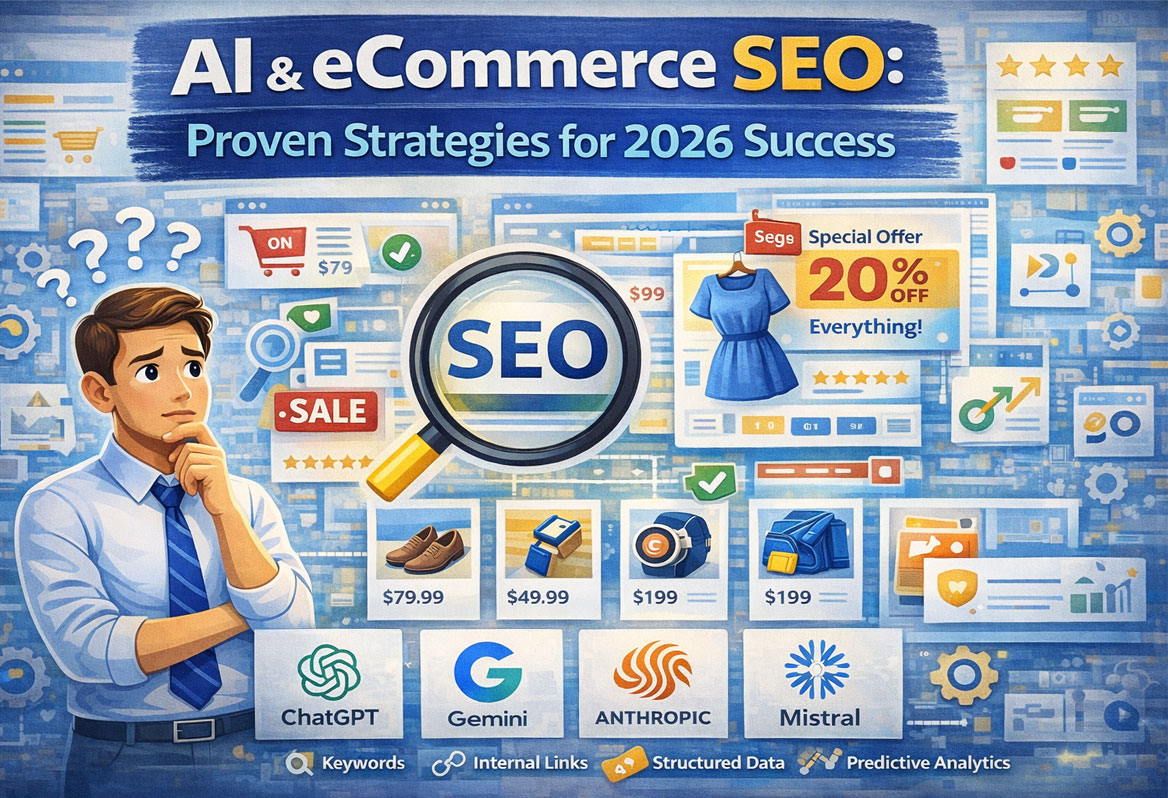
 AI is transforming eCommerce SEO in 2026, offering smarter automation and advanced optimization capabilities.
-
 AI-powered tools help optimize content, predict search trends, and improve rankings through data-driven insights.
-
 Personalized user experiences powered by AI increase engagement, conversions, and customer retention.
-
 Measuring ROI effectively ensures your AI investments deliver measurable SEO and revenue growth.
-
 By investing in the right tools and prioritizing user experience, you can future-proof your SEO strategy and stay ahead of the competition.
Introduction
Artificial intelligence is no longer just a buzzword, it’s a fundamental tool reshaping eCommerce SEO. As we move into 2026, businesses that fail to adopt AI-driven strategies risk falling behind their competitors. According to a 2025 BrightEdge report, AI now powers 40% of top-ranking content, making it indispensable for brands aiming to dominate search rankings.
From my experience working with eCommerce businesses, the real power of AI lies in its ability to analyze user behavior, predict trends, and personalize content. For instance, a Shopify store I worked with saw a 200% increase in organic traffic after implementing AI-driven content recommendations and optimizing their site structure. This guide will walk you through actionable strategies, tools, and case studies to help you integrate AI into your eCommerce SEO effectively.
Whether you’re running a small Shopify store or managing a large enterprise, understanding how to use AI in SEO can transform your results. We’ll explore everything from the best tools to future-proofing your strategy, ensuring you stay ahead of the curve in 2026 and beyond.
How AI is Reshaping eCommerce SEO in 2026
The Evolution of AI in SEO
AI has evolved from automating basic tasks to becoming a core component of SEO strategies. In 2026, AI’s capabilities extend far beyond keyword research and data analysis. Tools like Google’s RankBrain and BERT now interpret search queries with incredible accuracy, but the latest advancements focus on predicting user intent in real-time. This allows eCommerce brands to tailor their content and product offerings to meet specific audience needs.
A McKinsey report from 2023 predicted that AI would contribute $15 trillion to the global economy by 2030, with a significant portion coming from digital marketing and SEO. For eCommerce brands, this means AI is no longer optional—it’s a necessity.
Key AI Tools for Optimizing eCommerce SEO
In 2026, AI-driven tools are essential for optimizing eCommerce SEO. Tools like MarketMuse, Surfer SEO, and Clearscope provide actionable insights to improve content quality, keyword targeting, and site structure. For example, Surfer SEO helps create content that ranks higher by analyzing top-performing pages in your niche and offering optimization recommendations.
Another example is Clearscope, which aligns your content with user intent by analyzing top-performing content and suggesting relevant keywords. These tools not only save time but also ensure your content meets the latest SEO standards.
The Best AI Tools for eCommerce SEO in 2026
MarketMuse: Content Optimization Made Easy
MarketMuse uses AI to analyze your content and compare it with top-performing pages in your niche. It provides actionable recommendations, such as adding relevant keywords and improving readability. One client I worked with identified 20 new content opportunities using MarketMuse, resulting in a 30% increase in organic traffic within three months.
Surfer SEO: On-Page Optimization at Its Best
Surfer SEO offers real-time insights as you create or edit content. It suggests optimal keyword usage, word count, and content structure. A WooCommerce store I consulted for saw a 25% increase in conversions after optimizing their product descriptions with Surfer SEO.
Clearscope: Aligning Content with User Intent
Clearscope analyzes top-performing content to provide keyword and topic recommendations. A Shopify store I worked with experienced a 40% boost in organic traffic after implementing Clearscope’s suggestions.
Case Studies: Real-World Success with AI-Driven SEO
Case Study 1: Boosting Organic Traffic by 200% with AI
A mid-sized Shopify store struggled with stagnating traffic despite producing large amounts of content. After an SEO audit, we used MarketMuse and Surfer SEO to identify content gaps and optimize site structure. Within six months, organic traffic increased by 200%, and conversions grew by 150%.
Case Study 2: Increasing Conversions by 25% with AI-Optimized Product Descriptions
A WooCommerce store faced low conversion rates despite high traffic. We optimized their product descriptions using Surfer SEO and implemented AI-driven personalization techniques. Conversions increased by 25% within three months.
Measuring ROI: How to Track AI-Driven SEO Success
Key Metrics to Track
To measure the ROI of AI-driven SEO, focus on organic traffic, conversions, and keyword rankings. Tools like Google Analytics and Ahrefs provide detailed insights into these metrics.
Tools for Measuring ROI
Google Analytics tracks organic traffic and conversions, while Ahrefs monitors keyword rankings and backlinks. These tools help you make data-driven decisions to optimize your SEO strategy.
Future-Proofing Your eCommerce SEO Strategy
Staying Ahead of Algorithm Updates
Conduct regular SEO audits to adapt to algorithm changes. For example, after a major update, you might need to update your content or acquire new backlinks to maintain rankings.
Investing in AI-Driven Tools
Tools like MarketMuse and Surfer SEO provide insights into emerging trends and optimize your content. They ensure your site remains competitive as search algorithms evolve.
Focusing on User Experience
Search engines prioritize user experience, so ensure your site is mobile-friendly, loads quickly, and provides seamless navigation. This will help maintain your rankings as algorithms continue to evolve.
FAQ
FAQs
AI plays a critical role by providing insights, predicting trends, and optimizing content to improve search rankings and drive traffic.
AI analyzes user behavior and identifies emerging trends to suggest the most relevant keywords for your niche.
Start by analyzing your current performance, identify gaps, and integrate AI-driven tools to optimize your strategy for maximum ROI.
Use AI tools like Surfer SEO and Clearscope to optimize product descriptions, improve site structure, and align content with user intent.
Ready to Take Your eCommerce SEO to the Next Level?
Invest in AI-driven SEO strategies that deliver measurable growth. Whether you’re an eCommerce founder, SEO manager, or digital marketer, Sky Storm Digital can help you implement advanced SEO techniques to increase organic traffic, boost conversions, and future-proof your strategy. Explore our SEO services in Jaipur and start achieving your business goals in 2026 and beyond.

Pooja Garg
Pooja Garg is the founder of Sky Storm Digital, a creative digital marketing agency dedicated to helping brands grow through strategy, storytelling, and design. With a passion for blending creativity and data-driven insight, Pooja writes about digital marketing trends, brand building, and the ever-evolving online landscape.
When she’s not crafting campaigns, she’s exploring new ways to connect creativity with technology.