TL;DR
The right digital marketing agency brings measurable results, clear reporting, industry experience, and strategic thinking, not just services. Before signing any contract, evaluate their track record, communication structure, AI capabilities, team expertise, and whether their growth model aligns with your business goals.
Hiring a digital marketing agency is one of the highest-stakes decisions a business leader can make. The right agency can compound your revenue, sharpen your brand, and free your internal team to focus on what they do best. The wrong one can drain your budget, stall your growth, and leave you rebuilding from scratch.
The market is crowded. Thousands of agencies claim to deliver results but not all of them can. Knowing exactly what to look for when hiring a digital marketing agency separates smart investment from expensive disappointment.
This guide gives you the criteria, questions, and red flags you need to evaluate any agency with confidence.
What Does a Digital Marketing Agency Actually Do?
A digital marketing agency is a specialized external team that plans, executes, and manages your brand’s presence across digital channels to generate leads, traffic, and revenue.
Core services typically include search engine optimization (SEO), pay-per-click advertising (PPC), content marketing, social media management, email marketing, conversion rate optimization (CRO), and analytics reporting. Full-service agencies handle all of these under one roof. Specialist agencies focus on one or two channels with deep expertise.
The best agencies don’t just run campaigns, they act as strategic partners, aligning every channel to your business objectives rather than managing isolated tactics.
How to Evaluate a Digital Marketing Agency: 10 Key Criteria
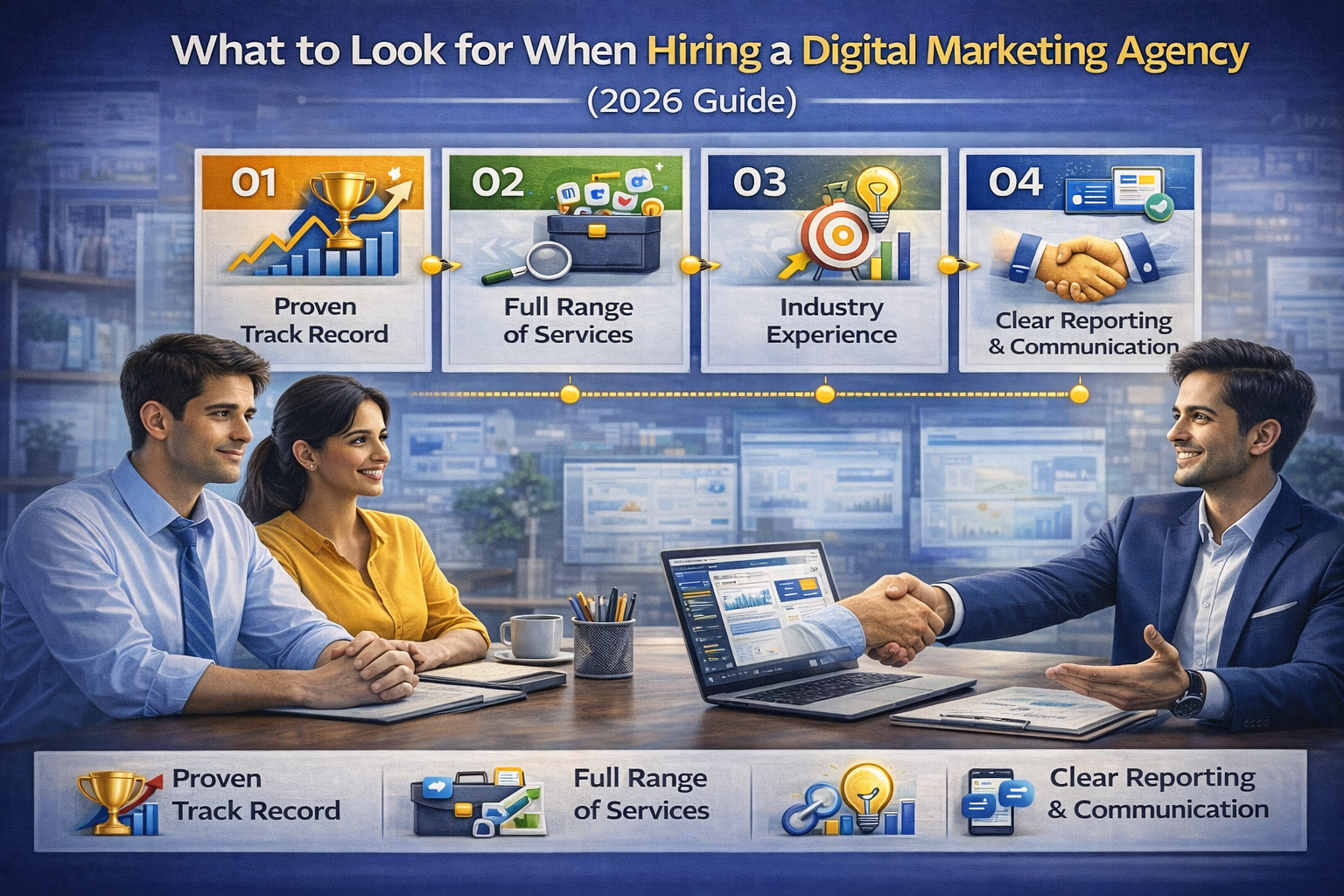
1. Do They Have a Verifiable Track Record?
The most important signal of agency competence is documented, specific results, not vague claims.
Any agency worth hiring should provide detailed case studies showing the exact strategies they used, measurable outcomes achieved, and how long it took. Look for specifics: “Increased organic traffic by 312% in 8 months” or “Reduced cost per lead from $87 to $34.” Marketing jargon is not evidence; numbers are.
Ask: Can you share 2–3 case studies from clients in my industry or a closely related vertical?
If the agency struggles to produce concrete examples, treat it as a significant red flag.
2. Do They Understand Your Industry?
Industry experience shortens the learning curve and sharpens strategy from day one.
An agency familiar with your sector already understands your buyer personas, competitive landscape, compliance requirements, and what messaging resonates with your audience. A healthcare brand has different digital needs than an e-commerce retailer or a B2B SaaS company and the strategy must reflect that.
Ask: Have you worked with businesses like mine? What industry-specific challenges have you solved?
Be cautious of agencies claiming deep expertise in every industry simultaneously, true specialization is narrow by nature.
3. Are Their Own Digital Channels Impressive?
If an agency can’t market itself, it cannot market you.
Before hiring an SEO agency, check where they rank for their own target keywords. Before hiring a social media agency, evaluate the quality and consistency of their own social content. Before hiring a content agency, read their blog. Their digital presence is their living portfolio and a direct demonstration of what they’ll build for you.
Ask: Can I see examples of your own internal campaigns and the results you’ve driven for your own brand?
4. What Is Their Reporting and Analytics Infrastructure?
Meaningful reporting is the foundation of accountable marketing.
Strong agencies track KPIs that connect directly to business outcomes not vanity metrics. “Increasing traffic” means little; “increasing qualified leads from organic search by 40%” means everything. Look for agencies that offer custom dashboards (tools like Looker Studio, Databox, or GA4-integrated reporting), clearly defined KPIs tied to your goals, and the ability to explain what’s working and why not just what the numbers say.
Ask: What does your reporting look like? How often will I receive updates, and who presents them?
Real-time visibility into performance is non-negotiable. You should never have to wait a month to discover that a campaign is underperforming.
5. How Do They Use AI and Where Do Humans Stay in Control?
In 2026, every credible agency uses artificial intelligence tools in some capacity. The question is how and whether human expertise still drives decisions.
AI tools can accelerate content drafting, keyword research, audience segmentation, and ad optimization. But agencies that rely on AI to replace strategy, creative judgment, or quality control are cutting corners at your expense. Google’s algorithm consistently penalizes low-quality, AI-generated content that lacks original insight and authority.
Ask: How does your team use AI in day-to-day operations? Where do humans review and refine AI outputs?
The right answer is a balanced one: AI for efficiency, humans for strategy, judgment, and brand voice.
6. Who Owns the Work And the Accounts?
Asset ownership is a critical but frequently overlooked contract issue.
Some agencies build your website, ad accounts, and analytics dashboards under their own logins making it nearly impossible for you to leave without losing everything. A trustworthy agency works inside your accounts, hands over all creative assets, and ensures you retain full ownership of everything produced, including landing pages, content, and advertising data.
Ask: Will I retain full ownership of all accounts, platforms, and creative assets if we end the relationship?
If the answer is vague or conditional, walk away.
7. Do They Have the Right Team Structure?
A reputable digital marketing agency deploys specialists, not generalists doing everything.
Effective digital marketing requires distinct expertise across SEO, paid media, content, design, analytics, and development. An agency that presents itself as a “full-service” operation staffed by one or two people is almost certainly spreading their attention too thin to deliver quality across all channels.
Ask: Who specifically will work on my account? What are their individual specializations and experience levels?
Meet the actual team members, not just the sales contact.
8. Is Their Communication Structure Clear and Consistent?
Communication quality predicts partnership quality.
Digital marketing is not a set-and-forget service. Campaigns require constant adjustment based on performance data, platform algorithm changes, and shifts in consumer behavior. Agencies that go dark between monthly reports, rotate account managers frequently, or respond slowly to questions are exhibiting signs of poor organizational health.
Ask: What is your communication cadence? Who will be my dedicated point of contact?
Confirm whether you’ll have weekly or bi-weekly check-ins, how day-to-day queries are handled, and what project management tools they use (Asana, Trello, etc.) to keep your campaigns on track.
Pricing clarity signals professional maturity.
Lowball pricing often hides cookie-cutter deliverables, inflated promises, or hidden upsells. Vague pricing structures, “it depends on your needs” without any further breakdown, signal a lack of process. Equally concerning: agencies that guarantee specific bottom-line results (guaranteed first-page rankings, guaranteed revenue increases) before they’ve even audited your digital presence. Legitimate agencies set realistic expectations based on data, not sales pressure.
Ask: Can you break down how you budget for strategy, labor, and media spend? What does success look like in the first 90 days?
10. Do They Align With Your Business Scale and Maturity?
The right agency at the wrong business stage is still the wrong agency.
Startups generally need agile execution partner teams that can test, iterate, and pivot fast across channels without demanding a sophisticated internal infrastructure on day one. Enterprises require specialists with deep data capabilities, scalable reporting systems, and experience managing large multi-channel programs. An enterprise-focused agency brought into a lean startup will impose processes the business isn’t ready for. A boutique agency engaged by a scaling enterprise will quickly exhaust their capacity.
Match agency scale to business maturity before evaluating anything else.
Red Flags: When to Walk Away
| Red Flag | What It Signals |
|---|---|
| Guarantees specific rankings or revenue | Overpromising, unethical tactics |
| High-pressure sales tactics (“sign today”) | Focused on closing, not serving |
| Vague reporting or no KPI framework | No accountability structure |
| Can’t produce relevant case studies | Inexperience or inflated claims |
| One-size-fits-all proposals | No real discovery or strategic thinking |
| Agency controls your accounts and logins | Asset hostage risk |
| No clear point of contact or team structure | Disorganized, high-churn operation |
| Their own digital presence is weak | Lacks proof of capability |
| Refuses to discuss AI usage | Behind on tools and transparency |
| Pushes black-hat tactics (cheap backlinks, etc.) | Risk of Google penalties |
Should You Hire a Full-Service or Specialist Agency?
The answer depends on your marketing maturity and goals.
A full-service agency manages all digital channels under one roof, SEO, PPC, content, social, email, and web. This is the right choice for businesses that want integrated strategy and don’t have the internal bandwidth to coordinate multiple vendors. The risk: full-service agencies can be broad but shallow in certain areas.
A specialist agency focuses exclusively on one or two channels with deep expertise. This is the right choice for businesses that already have strong internal marketing leadership and need external expertise in a specific area, for example, a paid media specialist or a technical SEO firm.
In practice, many businesses start with a specialist and expand to a full-service partner as their marketing operation matures.
Questions to Ask Before Signing Any Agency Contract
Before committing, ask every agency shortlisted these questions directly:
- Can you walk me through a specific case study that’s relevant to my industry?
- Who will manage my account day-to-day, and what are their qualifications?
- What KPIs will we track, and how do they connect to my business goals?
- How do you use AI in your workflows, and where does human review happen?
- Will I own all accounts, assets, and data if we end the engagement?
- What does onboarding look like, and when should I realistically expect to see results?
- How do you stay current with algorithm changes and platform updates?
- What’s your client retention rate, and can I speak to a current or past client?
How Much Does It Cost to Hire a Digital Marketing Agency?
Digital marketing agency pricing varies widely depending on the scope of services, agency size, and geographic market.
Retainer-based arrangements, the most common model typically range from $2,000 to $15,000 per month for small-to-mid-size businesses. Specialist agencies often charge project-based fees, which can range from $5,000 to $50,000+ depending on the engagement scope. Enterprise-level contracts with full-service agencies routinely exceed $20,000 per month.
The most important framing: don’t evaluate agency cost in isolation. Evaluate it against the projected return on investment. A $5,000/month agency that generates $50,000 in new revenue is far more valuable than a $1,500/month agency that generates noise.
Key Takeaways
-

Verify an agency’s track record with measurable case studies rather than relying solely on testimonials.
-

Choose agencies with relevant industry experience and a well-structured specialist team.
-

Ensure full ownership of all digital assets before signing any contract.
-

Evaluate how the agency leverages AI while ensuring human expertise still drives key decisions.
-

Match the agency’s size and specialization with your business scale and growth stage.
-

Look for transparent reporting focused on revenue-driven KPIs rather than vanity metrics.
-

Trust your instincts—if the sales process feels high-pressure or unclear, the partnership likely will too.
FAQ
FAQs
The most important factor is a verifiable track record of measurable results, specific case studies showing real outcomes for businesses similar to yours. Strategy and communication matter too, but proven performance is the non-negotiable baseline.
The top red flags are guaranteed rankings or revenue promises, high-pressure sales tactics, vague reporting structures, inability to produce relevant case studies, and agencies that retain ownership of your accounts and assets rather than working inside your own platforms.
Full-service agencies suit businesses that want integrated, multi-channel management and don’t have internal marketing leadership to coordinate multiple vendors. Specialist agencies are better for businesses with strong in-house marketing direction that need deep external expertise in a specific channel.
Ask directly how AI tools are integrated into their workflows and where human review is mandatory. A responsible agency uses AI for efficiency, drafting, research, data analysis while maintaining human oversight for strategy, brand voice, and quality control. Agencies that rely on AI to replace judgment are cutting corners that will cost you.
SEO results typically take 3–6 months to materialize in meaningful traffic growth. Paid media campaigns can show initial performance signals within 2–4 weeks, though optimization takes longer. Agencies that promise significant results in days or weeks without historical data to back it up are overpromising.
Ask what KPIs they track, how often they report, who presents the data, and whether reports are customized to your goals. Confirm whether you’ll have real-time access to a dashboard or must wait for monthly summaries. Ask specifically whether their KPIs connect to revenue outcomes not just traffic or follower counts.
Ready to Get Started?
If you’re ready to elevate your construction website’s SEO, Sky Storm Digital can help. Our team of SEO specialists focuses on enhancing construction sites to boost visibility, attract more leads, and foster business growth. Reach out today to discover more about our services and how we can support your SEO goals.
 Contact Us Today

Pooja Garg
Pooja Garg is the founder of Sky Storm Digital, a creative digital marketing agency dedicated to helping brands grow through strategy, storytelling, and design. With a passion for blending creativity and data-driven insight, Pooja writes about digital marketing trends, brand building, and the ever-evolving online landscape.
When she’s not crafting campaigns, she’s exploring new ways to connect creativity with technology.