SEO vs PPC: which channel drives better ROI for your business?
Key Takeaways
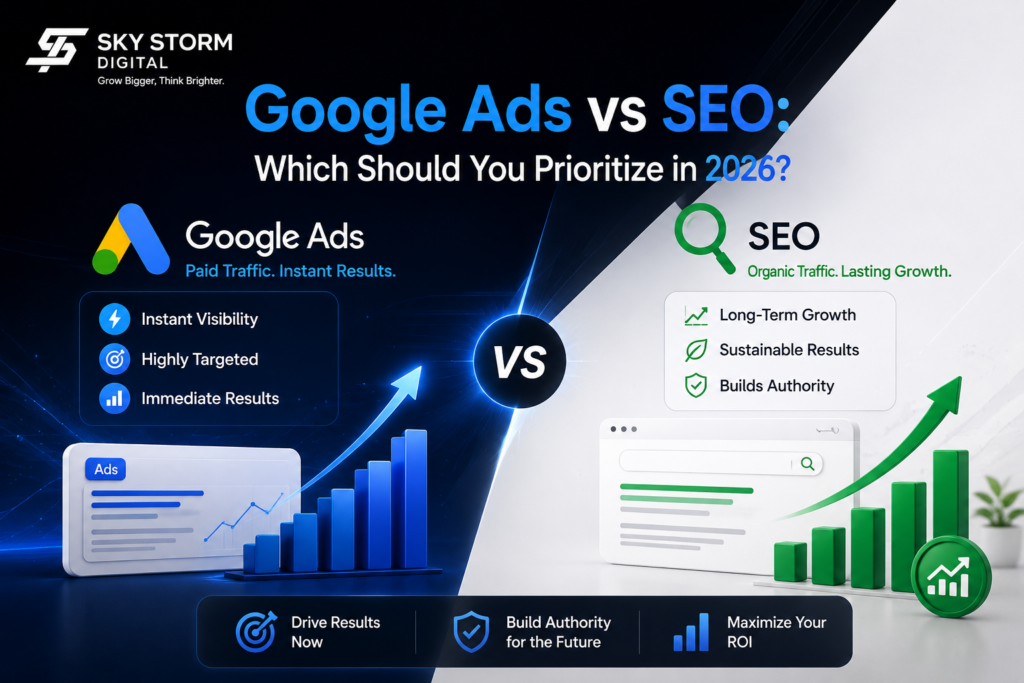
- SEO and PPC answer different business problems. SEO builds a compounding asset over time. PPC buys immediate, controllable traffic that stops the moment you stop paying.
- Cost-per-acquisition through SEO is typically lower than PPC after month six to eight, once rankings are established. Before that, PPC almost always wins on CPA.
- PPC is the right default when you need revenue now, are testing a new market, or are promoting a time-limited offer. SEO is the right investment when you’re building a sustainable acquisition channel for the next two to three years.
- Most businesses with a twelve-month horizon should run both: PPC for immediate demand, SEO building the organic foundation that reduces PPC dependence over time.
- The worst use of budget is running PPC indefinitely with no SEO investment, because you’re paying permanently for traffic that a competing business earns for free.
SEO vs PPC is usually framed as a binary choice. It’s not. The real question is which channel to prioritise first, at what budget split, and for how long before you rebalance. That answer depends on your timeline, your margins, your competitive landscape, and whether you need revenue in the next 60 days or you’re building for the next two years.
We’ve run both channels across service businesses, ecommerce sites, and B2B companies. The pattern that emerges across all of them is consistent enough to turn into a framework. Here it is.
How to compare SEO and PPC fairly
Most comparisons make the same mistake: they measure both channels at the same moment in time. SEO and PPC have completely different ROI curves. If you compare both at month two, PPC wins almost every time, because SEO hasn’t had time to build anything yet. Compare at month twelve and the picture shifts. Compare at month 24 and organic often wins by a significant margin. The timeline of the comparison changes the conclusion.
The fair comparison involves three variables:
- CPA (cost per acquisition), what does it cost to get one customer from each channel, including management costs?
- Traffic sustainability, what happens to traffic if you pause spend on each channel for 30 days?
- Compounding, does the investment build an asset that produces returns without proportional additional spend?
Run those three variables out over 12, 24, and 36 months and the comparison tells a different story than a single-month CPA snapshot.
SEO ROI: how it builds over time

SEO produces no immediate return. The investment in the first three months is entirely foundational: technical fixes, content creation, link building, local setup. Revenue attribution is near zero in this window. This is the period where businesses most often misread the channel as not working.
From month four to eight, rankings start to move for target keywords. Traffic begins, modest at first. CPA at this stage is typically high because you’re amortising the setup cost over a small volume of conversions. By month nine to twelve on a well-executed campaign, CPA starts declining. The content is published and performing. The rankings are established. Monthly effort is maintenance rather than build-out. The fixed cost portion shrinks relative to the traffic volume it’s generating.
From year two onwards, the math changes significantly. Content published in year one continues ranking and converting without additional investment. Semrush’s research on SEO ROI shows that organic search consistently outperforms paid channels in cost-per-acquisition for B2B and local service businesses once initial rankings mature. The channel is generating revenue from work that was paid for 18 months ago.
That compounding dynamic is what makes SEO the right long-term investment. Building a results-driven SEO plan structures exactly this kind of investment, sequencing content and technical work to hit compounding as fast as possible.
PPC ROI: the immediate case
PPC (Google Ads, Meta Ads, LinkedIn Ads) produces traffic immediately. On day one. If the campaign is set up correctly, you can have qualified traffic hitting a landing page within hours of launching. That immediacy is PPC’s primary advantage over SEO and it’s a real one.
The mechanics: you bid on keywords or audiences, pay per click (or per thousand impressions), and control who sees your ads precisely, by location, device, time of day, search intent, or demographic. You can test five different messages in a week and know which one converts. You can cap spend at exactly the budget you’ve committed. You can pause a campaign on a Friday and stop paying immediately.
The fundamental limitation: the traffic rents, it doesn’t buy. Every customer acquired through PPC requires a proportional ongoing spend. CPA stays relatively constant or increases over time as competition for keywords grows. There’s no compounding. A business running Google Ads for three years has no advantage over a competitor who started running the same ads last month (other than historical Quality Score data, which matters on margins).
According to WordStream’s Google Ads benchmark data, the average cost-per-click across industries runs $2 to $5, with professional services categories (legal, financial, medical) running $6 to $12 per click. For a business converting at 3%, a $4 CPC means a $133 CPA from clicks alone, before agency fees and management time. At a 1.5% conversion rate (closer to industry average), that’s $267 per acquisition.
Side-by-side comparison
| Factor | SEO | PPC |
|---|---|---|
| Time to first traffic | 3 to 6 months | Hours to days |
| Cost structure | Fixed monthly investment | Variable cost per click |
| Traffic if you pause | Continues (rankings persist) | Stops immediately |
| CPA at 12 months | Declining (setup costs amortised) | Stable or rising (competition) |
| Targeting control | Limited to keyword and content | Precise (location, device, time, audience) |
| Trust signals | High (organic results trusted more) | Lower (users know it’s an ad) |
| Testing speed | Slow (months per test) | Fast (days per test) |
| Compounding effect | Yes, content and rankings build on themselves | No, linear spend-to-result relationship |
| Ideal for | Long-term acquisition channel | Immediate revenue, time-limited offers, new market testing |
When to use SEO, when to use PPC, when to use both

Use PPC when: you need revenue in the next 60 days, you’re launching a new product or service with no existing rankings, you’re testing a new market or geography before committing to an SEO build, you’re running a seasonal promotion with a hard end date, or your target keyword is so competitive that SEO would take 12 to 18 months to reach the top three.
Use SEO when: you’re building for a 12 to 36-month horizon, your margins can absorb a 3 to 6-month ramp period before meaningful traffic arrives, you’re targeting high-intent informational keywords where organic results convert better than ads, or you’re in a category where users distrust ads (medical, legal, financial advice).
Use both when: you have the budget. Run PPC to generate immediate revenue while SEO builds. Use PPC conversion data (which keywords convert, at what CPA, on what landing pages) to inform your SEO content strategy. As organic rankings improve for specific keywords, reduce PPC spend on those terms and reallocate to new keywords where you don’t yet rank organically. The goal over 18 to 24 months is a shift toward more organic and less paid, reducing your cost of customer acquisition as the SEO investment matures. Understanding how to improve your site’s overall search visibility is part of making that shift happen faster.
Real-world scenarios
Scenario 1: Local service business, 12-month plan. Month 1 to 3: run Google Ads on high-intent local keywords (“plumber Jaipur emergency”) to generate revenue while the SEO foundation builds. Month 4 to 8: as organic rankings emerge for those same keywords, gradually reduce the PPC budget on terms where organic now ranks in the top five. Month 9 onwards: maintain PPC only for the highest-CPA keywords that haven’t yet ranked organically, using the budget freed up from better-performing PPC keywords.
Scenario 2: eCommerce brand, new product launch. Launch with PPC to validate the product page converts. Use the conversion rate data to optimise the page before investing in SEO. Once the page converts at above 2.5%, start the product page SEO optimisation and category page content build. At 12 months, compare CPA from organic vs paid and rebalance quarterly. A dedicated ecommerce SEO strategy built around product page authority compounds over the catalogue in a way PPC alone can’t replicate.
Scenario 3: B2B services, competitive national market. National head terms are too competitive for early SEO investment to deliver a realistic return in under 18 months. Start with long-tail and niche keywords that have conversion intent but lower competition. Supplement with LinkedIn Ads targeting specific job titles in target verticals. As long-tail content builds domain authority, gradually attack more competitive terms. PPC on branded terms (your brand name in search) is almost always worth running permanently at low spend to protect from competitor conquesting.
Not sure which channel is right for where your business is right now? Request a free audit and we’ll map out the right mix for your specific situation.
Frequently asked questions
Which has a higher ROI: SEO or PPC?
At 12 months and beyond, SEO typically produces a lower CPA than PPC for most business types, because the setup cost is amortised over growing traffic volume while PPC CPA stays constant or rises. At three months, PPC almost always wins on CPA because SEO hasn’t generated meaningful traffic yet. The ROI comparison is meaningless at a single point in time. Run the numbers at 12 and 24 months using your specific CPC, conversion rate, and SEO management cost to get an accurate picture for your market.
Can small businesses afford both SEO and PPC?
Budget determines the ratio, not the presence of both channels. A small business with Rs 50,000 per month in marketing budget might allocate 70% to PPC for immediate revenue and 30% to SEO for the long-term build. As the business grows and organic revenue increases, the ratio shifts. The mistake is spending 100% on PPC indefinitely, because the business remains entirely dependent on paid traffic with no compounding asset being built. Even a minimal SEO investment alongside PPC starts building equity that pays forward.
Does PPC affect SEO rankings?
No. Running Google Ads does not directly influence organic rankings. Google’s systems are separated: the paid auction is independent from the organic ranking algorithm. However, PPC indirectly informs SEO in two useful ways. First, PPC conversion data tells you which keywords drive revenue at what CPA, which is exactly the data you want to prioritise for SEO content investment. Second, brand awareness built through display and search ads can increase branded search volume, which is a mild positive signal in organic ranking systems.
How much does it cost to run Google Ads?
There’s no minimum. You can start with Rs 5,000 per month and test whether the channel works for your offer. The realistic minimum to generate statistically meaningful conversion data across a service business is roughly Rs 20,000 to 40,000 per month, depending on your category’s CPC. Professional services keywords (legal, finance, medical) carry higher CPCs and require larger budgets to generate enough click volume for optimisation decisions. The budget question is always relative to your average order value or customer lifetime value, if a client is worth Rs 50,000, even a Rs 5,000 CPA from PPC produces a 10x return.
What’s the best way to track ROI across both channels?
Set up conversion tracking in Google Ads and Google Analytics 4 with consistent goal definitions (form submissions, phone calls, purchases). Tag every PPC campaign with UTM parameters. In GA4, use the acquisition reports to compare CPA, conversion rate, and revenue by channel over the same time period. For SEO attribution specifically, filter GSC data to show non-branded organic keywords, then match those keyword clusters to your content investment to calculate content ROI by topic cluster. Run the comparison quarterly, not monthly, monthly data has too much noise from ranking fluctuations and seasonal patterns to be reliable for budget decisions.
Not sure whether to prioritise SEO or PPC for your budget right now? The Sky Storm Digital team runs channel audits that map your current traffic mix, your competitors’ channel investment, and your margin structure to give you a clear allocation recommendation.