TL;DR
-
Organic search still drives 53% of all website traffic (BrightEdge, 2026). SEO is not dead. It has simply become more competitive and sophisticated.
-
Google AI Overviews now appear in roughly 26% of U.S. searches. This is changing how users interact with certain search results, but not every query is affected.
-
The areas generating the strongest SEO traction in 2026 are Local SEO, Topic Clusters, E-E-A-T, and Generative Engine Optimization (GEO).
-
Most businesses see their first meaningful SEO movement within 3 to 6 months. Significant traffic growth typically takes 6 to 12 months.
-
Be cautious of agencies promising dramatically faster results. They may be using a very different definition of success or relying on risky tactics.
-
Businesses that adapt to AI-powered search while maintaining strong SEO fundamentals are best positioned for sustainable long-term growth.
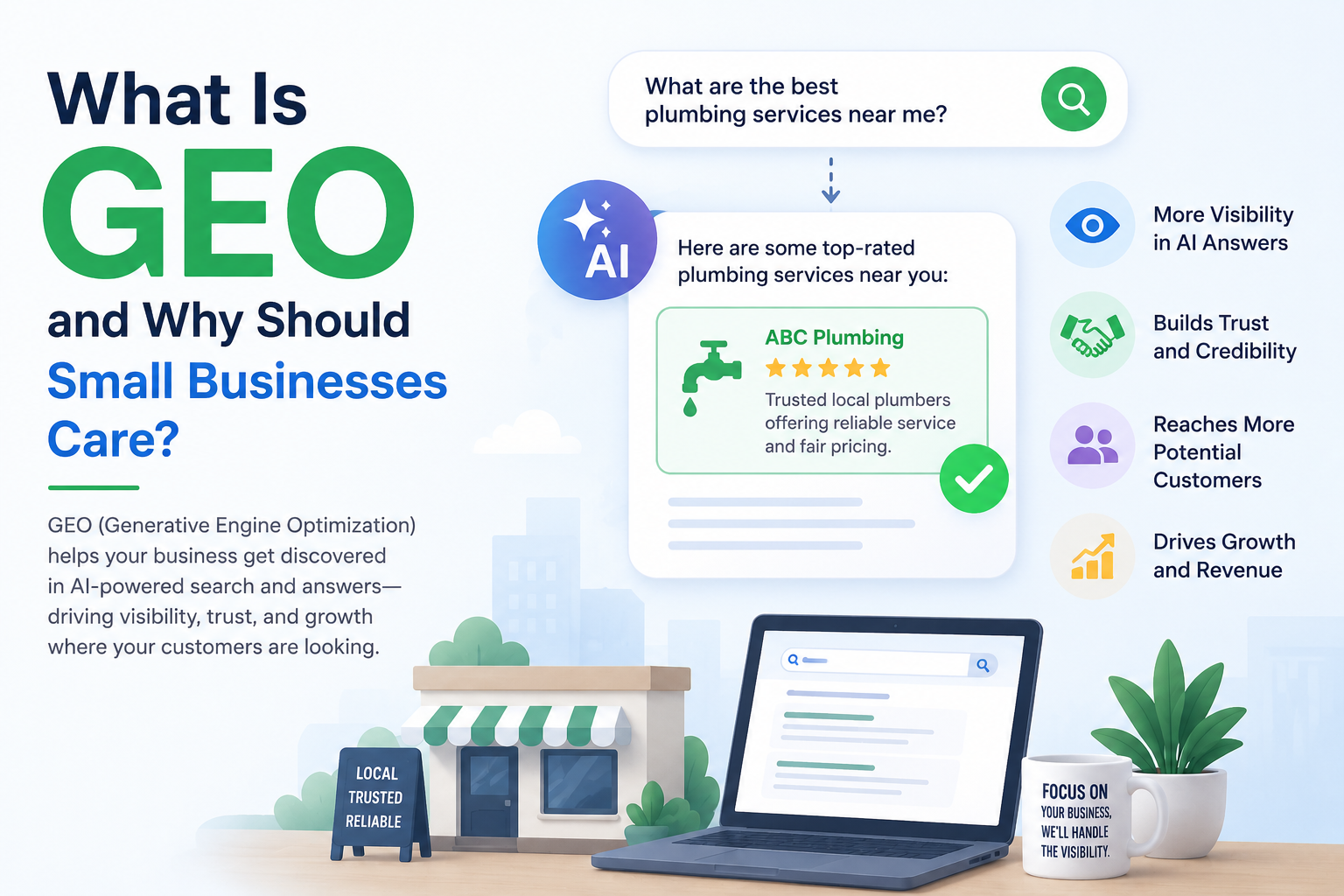
Table of Contents
1. Why Small Business SEO Is Harder in 2026 (And Still Worth It)
74% of small businesses are now investing in SEO (AIOSEO, 2026). More money, more competition that’s just the math. And Google processing 8.5 billion searches a day (SEMrush, 2026) sounds like good news until you factor in that AI Overviews are cutting click-through rates on informational queries by 15 to 46%, depending on the topic.
But here’s what that stat tends to obscure: the queries eating that CTR loss are mostly informational. How-to content, definition pages, research queries. Transactional and local searches like ’emergency plumber Chicago,’ ‘best accountant near me’ are barely touched. Those happen to be the searches that actually fill a small business’s pipeline.
Organic results still capture about 86% of all clicks on search results pages (Backlinko/SparkToro, 2026), and the gap between position one and position two is wider than most people realize. Moving up a single spot can increase your clicks by 74.5%. Over a year, the difference between ranking second and ranking first on a core service term can be substantial.
SEO in 2026 is harder. The argument for doing it anyway is that the compounding returns are real, most of your competitors are doing it badly, and organic traffic doesn’t vanish the moment you stop paying for it.
2. How Google AI Overviews Affect Small Businesses
By early 2026, AI Overviews were appearing in roughly 25.8% of US searches, with informational queries triggering them about 39% of the time (Digital Applied, 2026). If your traffic depended heavily on how-to and definition posts, some of that is gone or at least harder to recapture.
Before rewriting your entire content strategy around this, it’s worth figuring out which of your specific queries are actually affected. Pull your top traffic pages in Search Console and check which ones are getting AI Overview coverage. For most small businesses we work with, the revenue-driving queries sit in the low-impact zone. The sensible response is leaning harder into local and transactional content, not abandoning blog content wholesale.
If your site leans heavily on informational traffic, 2026 is a reasonable year to diversify. The GEO section covers one angle on that.
| Query Type | AI Overview Impact |
|---|---|
| Informational (how-to, definitions, guides) | High. CTR can drop 15% to 46%. |
| Local Intent (“near me,” city-based) | Low. Still drives Local Pack clicks. |
| Transactional (pricing, booking, purchase) | Very low. Users still need to complete a conversion. |
| Branded (your business name) | Minimal. Users already know your brand. |
We walk clients through their local SEO exposure before touching content strategy, because for most small businesses, that’s where the actual vulnerability is, not the blog.
3. What Is GEO and Why Should Small Businesses Care?

GEO aka Generative Engine Optimization is about making your content legible to AI-powered search engines: Google AI Overviews, Perplexity, ChatGPT Search, Gemini. These systems pull from the web the same way traditional search does, but they’re selecting for different things.
It’s not a replacement for SEO. More like an additional pass you do on content you’re already publishing. The fundamentals overlap heavily, clean structure, credible sourcing, clear authorship.
Where GEO diverges from standard SEO practice:
- Direct answer blocks. Format H2s as questions. Put a concise, standalone answer in the first sentence or two after the heading before any context or nuance. That’s what gets pulled for AI summaries.
- Entity clarity. Spell out your business name, location, and service category in the body of the content. Don’t assume the AI knows what ‘we’ means.
- Sourced specifics. Three to five concrete, cited data points per major section. AI systems quote statistics, not general claims.
- E-E-A-T signals. Author bios, a visible last-updated date, and a few outbound links to credible sources. These matter for traditional rankings too, but AI crawlers seem to weight them more explicitly.
We’re still figuring out GEO at small business scale, anyone claiming otherwise is probably overselling it. What we can say is that clearly written, well-attributed content on topics your site has genuine depth on does appear to get cited in AI summaries more often than thin, keyword-stuffed pages. Which is not that different from what’s always worked.
4. How to Build Topic Clusters on a Small Budget
A topic cluster is one pillar page, a long, comprehensive guide on a broad topic supported by a set of shorter posts covering related subtopics, all linked together. The structure signals to Google that you have real depth on a subject rather than scattered coverage.
The mistake we see most often: trying to build too many clusters at once. Ten tightly connected posts on one topic will consistently outperform fifty scattered posts across ten different areas. Pick one thing and go deep before expanding.
A sequence that works in practice:
- Choose a topic you actually know. It should connect to what you sell, sit in an area your competitors haven’t fully addressed, and be something you can write about from first-hand experience not just from research.
- Write the pillar page before anything else. 2,500 to 4,000 words, covering the topic end-to-end. It links out to every supporting post. Each supporting post links back up to it.
- Map six to ten supporting posts. Pull these from PAA questions in Google, subtopics the pillar touches on but doesn’t go deep on, and specific questions you hear from clients.
- Be deliberate about internal links. Every new post should link to the pillar and to your service pages. Getting this architecture right matters more than most people realize.
- Set a pace you can actually hold. Two solid posts per month is better than ten rushed ones. And publishing thin content on a schedule is genuinely worse than publishing nothing it trains Google to expect low-quality output from your domain.
5. Why Local SEO Is Still the Fastest Win
Of everything in the SEO toolkit, local is where small businesses tend to see the fastest returns. 46% of all Google searches carry local intent (Think with Google / BrightEdge, 2026) searches from people who are close to deciding, not just researching.
Google Business Profile
An actively managed Google Business Profile with updated hours, recent photos, responses to reviews, at least monthly posts will regularly outperform a well-optimized website for local pack visibility. The gap between businesses that maintain their profile and those that set it up once and forget it is wide, and it’s exploitable.
Review Velocity
Google is putting more weight on how recently you’ve received reviews, not just how many you have. A business sitting on 30 reviews from 2023 is at a real disadvantage against one with 15 reviews from the past three months. This is fixable: make the review link easy to share, follow up with customers after each job, and respond to every review publicly including the negative ones.
Location-Specific Pages
‘Plumbing services in Jaipur ranks better than ‘Plumbing services’ for someone searching in Jaipur. If you cover multiple neighborhoods or cities, a dedicated page for each is worth building but only if each one has genuinely distinct content. Swapping the city name into a template and republishing won’t help, and can create duplicate content problems that hurt your other pages.
When we audit small business sites for local SEO, the fastest gains are almost always in the same two places: Google Business Profile and citation cleanup. New content can come later. Get the foundation solid first.
6. What Technical SEO Basics Actually Matter?
| Technical Factor | Why It Matters in 2026 |
|---|---|
| Core Web Vitals (LCP, CLS, INP) | Google’s page experience signals remain important. Failing these metrics can hurt rankings, especially on mobile. |
| Mobile-First Indexing | 62.5% of global traffic comes from mobile devices. Your mobile experience is effectively your Google experience. |
| Crawlability and Indexation | If Google cannot crawl and index your pages, none of your other SEO efforts will matter. |
| HTTPS / Site Security | Non-HTTPS websites face trust and ranking disadvantages. Secure browsing is now a baseline expectation. |
| Schema Markup | Structured data helps search engines and AI crawlers better understand and surface your content. |
| Page Speed | A load time under 3 seconds is the benchmark. Slow websites lose visitors before they have a chance to rank. |
7. How to Use E-E-A-T to Build Trust with Google
E-E-A-T aka Experience, Expertise, Authoritativeness, Trustworthiness is how Google evaluates whether a piece of content is worth ranking. In 2026 it’s also a rough proxy for how AI systems decide whether to cite you. The good news is the signals are practical.
- Real author bylines. If your team writes your blog content, each post needs an author name and a short bio explaining why that person knows what they’re talking about. ‘Staff writer’ tells Google nothing.
- First-person specifics. Content that references actual client work, real numbers from real projects, or candid assessments of what didn’t work will outrank content that stays at the surface level. Google has gotten better at detecting the difference, and AI systems seem to weight it heavily.
- Last-updated dates. Stale content loses authority without any obvious signal. Two years without a refresh is worth flagging either rewrite it or redirect it.
- Outbound links to credible sources. Two or three per long-form post pointing to industry studies or authoritative publications. This signals trustworthiness rather than undermining your originality.
On AI-assisted content: we’re not dogmatic about it. We keep the ratio of AI-generated text in client content below a threshold we’re comfortable defending, but the more useful question is whether the content is accurate, relevant, and genuinely useful to someone reading it. Google has always tried to reward that. The tools used to produce the content matter less than whether it clears that bar.
8. How Long Does SEO Take for Small Businesses?
A realistic breakdown:
| Timeframe | What to Expect |
|---|---|
| 0 to 3 Months | Technical cleanup, content foundations, and Google Business Profile optimization. |
| 3 to 6 Months | Initial ranking improvements on lower-competition keywords, assuming a solid technical foundation is in place. |
| 6 to 12 Months | Meaningful organic traffic growth on your primary service and target keywords. |
| 12 to 24 Months | Improved visibility for competitive head terms and the benefits of compounding topical authority. |
Local SEO on Google Business Profile is faster often 30 to 90 days before you see visible impact. Content SEO targeting national terms is a different conversation; call it 12+ months, minimum. If someone’s promising page-one results in 30 days, ask them what terms and what starting position.
The compounding argument for SEO is worth taking seriously. Every piece of content you publish, every technical issue you fix, every review you collect, these stack over time. A business 18 months into a consistent SEO program has built something a new competitor will need 18 months to replicate. That asset doesn’t reset when you stop paying for ads.
We’ve had clients come in expecting to compete on difficult terms with 16 hours of work per month. The honest answer is that the scope you commit to determines the outcome you can realistically expect. Before making any SEO commitment, it’s worth mapping what your budget can actually buy.
Frequently Asked Questions
From what we see working: local SEO built around an active Google Business Profile, a single topic cluster developed around your core service area, and a technical audit to clear anything blocking Google from crawling your pages properly. GEO optimization is worth adding on top of that, particularly if your audience uses Perplexity or ChatGPT for research.
Yes. AI Overviews have hit CTR on informational queries hard up to 46% in some categories. But transactional and local queries are largely unaffected, and those are the ones that tend to drive revenue for small businesses. The question worth asking isn’t whether SEO works, it’s which of your specific keywords are in the affected zone.
GEO is about structuring content so AI-powered search engines, Google AI Overviews, Perplexity, ChatGPT Search can understand, cite, and surface it. It builds on standard SEO practice but puts particular weight on question-format headings with direct answers immediately following. For most small businesses, it’s not a separate discipline so much as an extra pass on content you’re already publishing.
Depends on what you’re trying to accomplish. At the lower end $500 to $1,500 per month, you’re covering tools and some content production, probably not much else. A fuller program that includes content, link building, technical maintenance, and reporting tends to run $2,000 to $5,000 per month for a small business. That range exists because the scope varies a lot. What you can buy with $1,000 a month is just different from what you can buy with $4,000.
Mostly geography and the competition level that comes with it. Local SEO is built around Google Business Profile, local citations, and location-specific pages, it targets searches that include a city name or ‘near me.’ National SEO goes after broader terms with no geographic qualifier, which generally requires substantially more content and domain authority to compete on. Most small businesses are better served building local authority first and expanding nationally once they have a foundation to build from.
On lower-competition and local keywords, we typically see first movement at 3 to 6 months. Meaningful organic traffic enough to matter to revenue comes between 6 and 12 months on most service terms. Competitive terms in crowded markets can take 12 to 24 months. Google Business Profile optimization is the exception: you can see local pack improvements in 30 to 90 days. Page-one guarantees in 30 days are a red flag, full stop.
Where to Start
If you're building from scratch or trying to restart a strategy that stalled, begin with your Google Business Profile, then complete a technical SEO audit to eliminate any blocking issues. Next, focus on building a single topic cluster consistently over six months and incorporate GEO optimization as you publish new content.
SEO in 2026 requires more precision and patience than it did a few years ago. The advantage is that organic traffic remains one of the most durable growth channels available. Unlike paid advertising, it continues delivering value long after the initial investment has been made.
If you'd like an expert assessment of your website, our team at Sky Storm Digital can help identify what is working, uncover opportunities for growth, and prioritize the actions that will have the greatest impact.
Pooja Garg
Pooja Garg is the founder of Sky Storm Digital, a creative digital marketing agency dedicated to helping brands grow through strategy, storytelling, and design. With a passion for blending creativity and data-driven insight, Pooja writes about digital marketing trends, brand building, and the ever-evolving online landscape.
When she’s not crafting campaigns, she’s exploring new ways to connect creativity with technology.