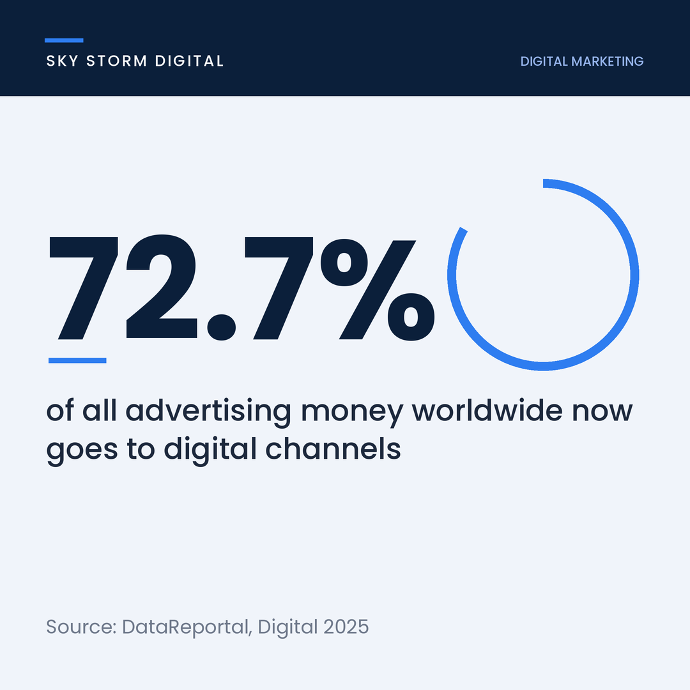
Every time someone searches Google for a plumber or taps an ad on Instagram, they walk through a channel that a marketing team built on purpose. That is digital marketing at work, and it now takes the majority of what businesses spend to reach customers. Digital channels pulled in 72.7 percent of worldwide ad investment in 2024 (DataReportal). This guide walks a beginner through what it is, the channels worth knowing, how it beats traditional advertising on measurement, and where to actually start.
What You Need to Know About Digital Marketing
Digital marketing gives businesses a measurable way to reach customers, generate leads, and grow online.
Digital Marketing Happens Online
Digital marketing is any promotion that runs through a connected device. It includes search engines, social media, email, websites, and other digital channels. Unlike many traditional marketing methods, digital activity can be measured click by click.
Your Customers Are Already Online
The reach is already there. According to DataReportal , 5.56 billion people use the internet. The question is not whether your customers are online, but how effectively you reach them.
Focus on the Right Channels
The core channels are SEO, paid search, social media, email, and content marketing. Most small businesses do not need to use every channel. Combining two or three channels and doing them well can often produce better results.
Measure What Matters
Measurement is one of digital marketing’s biggest advantages. You can track traffic, leads, conversions, and revenue to understand which campaigns and channels are actually contributing to business growth.
Start With One Goal
Start with one goal and one channel. Choose the channel where your customers already spend their time, set one primary success metric, and expand your strategy once the initial channel is producing measurable results.
Table of Contents
What is digital marketing?
Digital marketing is any marketing that reaches people through an internet-connected device: search engines, websites, social media, email, apps. That is the textbook line. The useful part is the feedback. Every click and sale traces to the campaign that caused it, so the whole thing behaves more like a spreadsheet than a poster on a wall.
Run a Google Ads campaign and you can see the exact phrase someone typed before they clicked, how many people clicked, and how many of them booked. Try pulling that off a newspaper ad. You cannot.
One term you will hit constantly, so let us settle it now. Search Engine Optimization (SEO) means improving your website so it ranks higher in the unpaid Google and Bing results. More on that in a moment, along with the rest of the channels.
Why does digital marketing matter for your business?
Your customers are already online, and that is where most of their attention goes now. At the start of 2025, 5.56 billion people use the internet, 67.9 percent of the planet (DataReportal), and 5.78 billion carry a mobile phone (DataReportal). Someone hunting for a dentist, a caterer, or a payroll tool starts that search on a screen, usually a phone in their hand.
The money went where the attention went. Global ad spend crossed 1.17 trillion dollars in 2025, up 7.4 percent on the year (WARC), and digital took most of it. That shift is good news if you are small. You do not need a television budget to show up. A tight search campaign or a solid local listing can put you in front of a buyer on the day they are ready to spend, and you can start on a few thousand rupees rather than a few lakh.
There is a second reason, and it tends to get missed. You can fail cheaply. Test a headline, a landing page, or an audience on a small spend, keep the winners, and quietly kill the rest. Traditional advertising almost never gives you that feedback loop.
What Are The Main Types Of Digital Marketing?
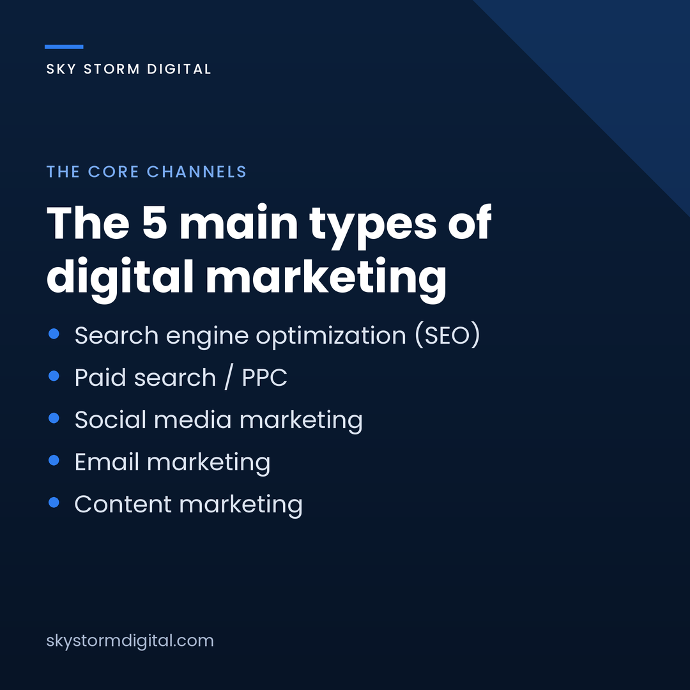
Five channels cover most of what a beginner needs: SEO, paid search, social media, email, and content marketing. You will not run all five at once, and you should not try. Which ones earn a place comes down to where your buyers spend time and how they decide to spend money. We will take them one at a time, starting with the one everyone asks about.
Search engine optimization (SEO)
Type “best accountant in Jaipur” into Google. The businesses sitting on page one that did not pay for the slot got there through SEO, the work of earning unpaid, or organic, rankings. Three things move it: the content on your pages, the technical health of the site, and the links other sites point back at you.
Why does everyone fixate on it? Scale. Google holds 91.31 percent of the worldwide search market (StatCounter), so ranking on Google is close enough to ranking everywhere. The catch is patience. SEO compounds over months, not weeks, which is why we usually run a paid channel alongside it to bring traffic in while the rankings climb. Our SEO service work in Jaipur is built around that slow compounding curve.
Paid search and pay-per-click (PPC)
Paid search flips the timeline entirely. Pay-Per-Click (PPC) means you bid to sit at the top of the results and pay only when someone actually clicks. Google Ads runs this show. For a beginner the draw is control: pick your keywords, set a daily cap, and turn the spend up or down by lunchtime.
It is also the quickest way to find out whether demand is even there. Not sure anyone searches for what you sell? A small campaign will tell you inside a week. Search still takes the biggest slice of digital budgets, roughly 40 percent of the total, more than 316 billion dollars in 2024 (DataReportal). One rule we never bend: do not point paid clicks at a weak page. Paid traffic magnifies whatever that page already does, for better or worse.
Social media marketing
Social media marketing puts you on Instagram, Facebook, LinkedIn, or YouTube to build an audience and run targeted ads. Two halves. The organic side is your free posts to the people already following you. The paid side is the advertising that reaches everyone else.
The scale is hard to argue with. 5.24 billion people hold a social media identity (DataReportal), and advertisers put close to a quarter of a trillion dollars in front of them in 2024, up 15 percent on the year before (DataReportal). For a local shop, or a product that photographs well, this is often where the first real traction shows up. Our social media marketing approach leans hard on paid targeting to shorten the gap between a post and a lead.
Email marketing
The channel nobody brags about quietly beats most of the others. Email marketing is sending messages to a list of people who asked to hear from you. Oldest tool in the digital box, and still the most efficient one running: 36 dollars back for every 1 dollar spent (Litmus), on average, a number nothing else matches with any consistency.
So why does a decades-old channel keep winning? You own the list. An algorithm change at Google or a feed tweak at Instagram cannot take your subscribers away from you. A plain welcome sequence and one decent monthly newsletter will out-earn a lot of flashier work.
Content marketing
Content marketing is making things people genuinely want, articles, videos, guides, the odd calculator, without the hard sell stapled on top. The guide you are reading is content marketing. It answers a real question first, and earns a bit of trust before it asks for anything.
Treat content as the fuel the other channels burn. SEO has nothing to rank without pages. Social and email have nothing to send. We build the content first and let the other channels carry it, rather than parking it in a silo of its own.
Digital Marketing Channels at a Glance
Each digital marketing channel has different strengths, costs, and timelines. Choose the channels that best match your business goals and customers.
| Channel | Speed to Results | Typical Cost Model | Best For |
|---|---|---|---|
| SEO | Slow, compounds | Time or agency retainer | Long-term organic traffic |
| Paid search (PPC) | Fast | Per click | Testing demand, immediate leads |
| Social media | Medium | Per impression or click | Brand building, visual products |
| Fast | Per send or monthly tool fee | Repeat sales, retention | |
| Content | Slow, compounds | Production cost | Trust, SEO fuel, education |
How Does Digital Marketing Work?
Underneath the channels, the job never changes: move a stranger, one step at a time, from never hearing of you to paying you, and measure every step on the way. Marketers draw this as a funnel. Wide at the top where people first notice you. It narrows through the middle as they weigh you up, and comes to a point at the bottom where they buy.
Each channel pulls a different shift. Social and content mostly work the top, putting you in front of people who had no idea you existed. Search, paid and organic both, catches people further down, once they are actively hunting for a fix. Email threads through the whole thing, nudging people from one stage to the next.
What ties it together is tracking. A snippet of code on your site, usually Google Analytics, logs where each visitor came from and what they did, and the ad platforms hand back their clicks and conversions. Connect those and you can follow one sale back to the ad that first caught someone and the email that finally closed them. That is the entire point, and it is the logic behind our full set of marketing solutions. No more guessing which half of the budget is doing the work.
Digital Marketing Vs Traditional Marketing
Traditional Marketing vs. Digital Marketing
Digital marketing gives businesses more control over targeting, measurement, cost, and how quickly campaigns can be adjusted.
| Factor | Traditional Marketing | Digital Marketing |
|---|---|---|
| Measurement | Limited, estimated | Precise, per click |
| Targeting | Broad demographics | Specific interests and intent |
| Cost to Start | High | Low, scalable |
| Speed to Adjust | Days or weeks | Minutes |
| Best Strength | Mass local awareness | Traceable leads and sales |
How Do You Measure Digital Marketing?
Measurement is where beginners either win or drown, and most drown, usually in dashboards. The fix is boring. Pick the few numbers that map to your goal and ignore the rest until those feel like second nature.
Four to learn first:
- How many people land on your site, and which channel sent them. Google Analytics reports this for free.
- Conversion rate. The share of visitors who do the thing you want, a form fill or a purchase. A 2 percent rate means 2 of every 100 visitors act.
- Cost per lead or acquisition. What you spend to earn one enquiry or one customer. This is the number that decides whether a channel stays or goes.
- Return on investment (ROI). The revenue a channel brings against what it costs to run. Email’s 36-to-1 average return (Litmus) is a useful benchmark, though your own numbers beat any industry average.
Start there. A free marketing audit will show where your current presence stands before you spend a paisa, but the number to watch from day one is cost per lead. Chasing traffic while ignoring what a lead costs is how businesses end up busy and broke at the same time.
How To Build A Beginner Digital Marketing Plan
A first plan should be almost embarrassingly small. No channel on every platform. One goal, one channel that genuinely reaches your buyers, one number that tells you it is working. The order we hand people starting from zero:
- Set one goal. Name a single outcome for the next 90 days, say 20 qualified enquiries a month. “More brand awareness” cannot be measured, so it cannot be managed.
- Know your customer. Write down where your ideal buyer spends time online and the words they type when they need you. That decides your channel.
- Choose one primary channel. A local service business often starts with local SEO plus Google Ads. A visual product brand often starts on social. Resist doing all of it.
- Build a simple website that converts. Every channel sends traffic somewhere. If that page is slow or muddled, the spend is wasted. Fix the destination before the traffic.
- Set up tracking. Install Google Analytics and connect your ad accounts before you spend a rupee, so day one has numbers.
- Run, measure, and adjust. Give a channel four to six weeks, read the results, then double down or change course.
The businesses that grow fastest usually pick one channel and pour more into whatever the numbers reward. Spreading across every platform mostly produces motion without money. If you would rather have a team run this play with you, working with a digital marketing agency in Jaipur can compress months of trial and error into a plan you can start on Monday.
FAQ
Frequently Asked Questions
Three jobs, really. It gets you in front of people while they are online and looking, then tracks whether they act. That covers awareness, reaching people who have never heard of you, and demand capture, pulling in people already searching for what you sell. Winning back past customers is the third job, and usually the cheapest growth you will find.
The core five are SEO, paid search or PPC, social media, email, and content marketing. Search alone takes around 40 percent of digital ad spend (DataReportal), which tells you how much buying intent lives there. Most small businesses do best focusing on two or three rather than spreading thin across all of them.
Yes. Global ad spend passed 1.17 trillion dollars in 2025 (WARC), and most of that growth is digital, so demand for people who can run campaigns and read data keeps climbing.
Social media marketing is one channel inside digital marketing, not a synonym for it. Digital marketing is the whole field: search, email, content, websites, and paid advertising alongside social. Run only Instagram and Facebook and you are doing social media marketing. Add SEO, Google Ads, or an email list and you are running a broader program where the channels start feeding each other. Picture social as one room in a much larger house, and the rooms connect.
Yes, and plenty of owners start exactly that way. Email, organic social, and basic local SEO are all learnable on a small budget. Most owners bring in help for paid advertising, where one wrong setting can burn money fast, and for technical SEO, where the work gets specialized.
Conclusion
Strip it all back and digital marketing is just meeting customers where they already are, with the bonus that you can measure nearly everything you try. You do not need every channel, and you do not need a big budget to start. Pick the one place your buyers already pay attention. Set a single goal, get tracking in before you spend a rupee, and read the numbers weekly. Growth online usually comes from starting small and pouring more into whatever pays, not from being everywhere at once. Choose your first channel and give it six honest weeks before you judge it.

Pooja Garg
Pooja Garg is the founder of Sky Storm Digital, a creative digital marketing agency dedicated to helping brands grow through strategy, storytelling, and design. With a passion for blending creativity and data-driven insight, Pooja writes about digital marketing trends, brand building, and the ever-evolving online landscape.
When she’s not crafting campaigns, she’s exploring new ways to connect creativity with technology.