Type a question into Google and you get ten blue links back in half a second. Someone decided the order of those links, and it wasn’t random. SEO is how you climb toward the top of that list without paying for the spot. For most websites, it brings in more traffic than any other channel, and according to BrightEdge, organic search accounts for 53 percent of all website traffic. Below we cover what SEO is, how search engines decide what ranks, the three parts you can control, and where a beginner should start.
What You Need to Know About SEO
SEO helps your website earn visibility in search engines by making it useful for people and easy for search engines to understand.
SEO means earning unpaid rankings on search engines by making your site something Google both trusts and can easily read.
Three parts do the work: on-page, off-page, and technical SEO. Content and keywords, links and reputation, and the plumbing that lets Google crawl your site.
Position one is where the clicks are. The top organic result takes an average 27.6 percent of clicks (Backlinko), and almost nobody reaches page two.
SEO is slow on purpose. Only 5.7 percent of new pages rank in the top 10 within a year (Ahrefs), so treat it as a compounding asset, not a quick win.
Start with one thing done right. Fix how your site reads to Google, write one genuinely useful page, and measure it in Google Search Console before you scale.
Table of Contents
What is SEO?
SEO stands for Search Engine Optimization. In plain terms, it’s the work you do to a website so it shows up higher in the unpaid results on Google and Bing. No ad budget involved. You earn that position by being the most useful, trustworthy, readable answer to whatever someone typed into the search bar, and the ranking sticks around only as long as that stays true.
Picture the results page split in two. Up top sit the ads, labelled “Sponsored”, which businesses pay for by the click. Everything below them is organic, and no amount of money buys a spot there. SEO is how you compete for it.
The payoff is that organic clicks keep coming long after the work is done. Stop paying for ads and the traffic dries up that same afternoon. A page that ranks well can pull in visitors for years. That’s the difference between renting attention and owning it.
How does SEO work?
Search engines run on three steps, and your job is to make each one easy for them. Crawling comes first. Bots move through the web by following links from page to page, and whatever they reach gets pulled back for processing. Indexing is the filing stage, where each page lands in a huge database sorted by what it’s about. Then ranking: when someone types a query, the engine pulls the pages that match and puts them in order based on relevance and quality.
Google leans on hundreds of signals to decide that order. You don’t need to memorise them. Most collapse into three questions the algorithm is really asking. Does this page match what the person meant, beyond the exact words they typed? Can somebody use it on a phone without sitting there watching it load? And do other credible sites treat it as worth linking to?
Beginners miss one thing. Google can’t rank a page it never found, and it won’t rank a page it can’t understand. A lot of SEO is unglamorous plumbing, making sure your pages can be crawled, load quickly, and tell a search engine plainly what they cover. Get that wrong and the best content in the world sits invisible.
The three components of SEO
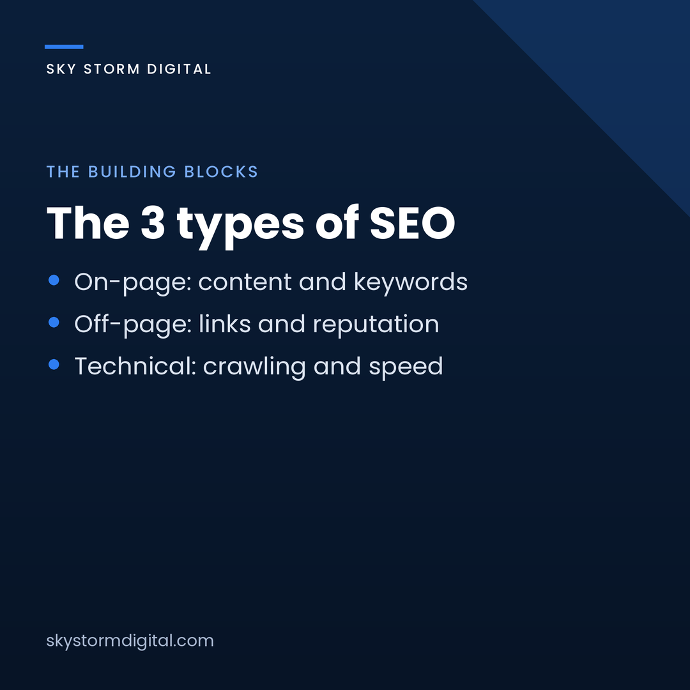
Everything in SEO falls into one of three buckets: on-page, off-page, and technical. A healthy strategy works on all three. But if you’re just starting out, on-page is usually where you’ll see movement first, partly because it’s the only bucket you fully control, and partly because the fixes are concrete enough that you can knock out a dozen of them in an afternoon and watch what happens.
On-page SEO
On-page SEO covers everything you control on the page itself. The words, the headings, the images, how directly you answer the query. Start with keyword research, meaning the exact phrases your customers type into the search bar, and then build content that’s genuinely useful around those phrases rather than stuffing them in. Title tags, meta descriptions, header structure, internal links: all of it lives here too.
The rule we hold to is simple. Write for the person first, then make sure a search engine can follow along. A page stuffed with keywords reads badly, and these days it also ranks worse than the same page would have five or six years ago, back when repetition still counted for something. If you run a store, our ecommerce SEO work sits almost entirely here, tuning product and category pages to match how people shop.
Off-page SEO
Off-page SEO covers the trust signals that happen away from your site. Backlinks are the big one. When another reputable website links to yours, Google reads it as a vote of confidence, and that vote carries weight roughly in proportion to how much the linking site is itself trusted by the rest of the web. Ten links from respected industry sites will move you further than a hundred from random directories. We’ve seen that gap play out often enough to stop being surprised by it.
You can’t fully control this, and that’s the point. Earned links, brand mentions, and reviews are hard to fake, so search engines weight them heavily. For a local business, this overlaps with local SEO in Jaipur, where citations, Google Business Profile signals, and reviews decide who shows up in the map pack.
Technical SEO
Technical SEO is the plumbing. Site speed, mobile friendliness, a clean structure, an XML sitemap, secure HTTPS, no broken links or crawl errors piling up in Search Console. Your visitors never see any of it. But if Google’s crawler hits a wall somewhere in that list, nothing else you do on the page matters much, because the page has to be readable before it can rank.
You don’t need to be a developer to start. Google Search Console is free, and it’ll flag most of the problems for you. A crawler like Screaming Frog will find broken links and missing tags in a single pass, which is usually enough to see where things are going wrong before anyone starts guessing. Fix the errors it surfaces before you spend a rupee on anything else.
Why does SEO matter?
Ranking well matters because the clicks are stacked at the very top and drop off a cliff after that. The first organic result earns an average 27.6 percent of all clicks, according to Backlinko. Everything below that is scraps. By the time you’re near the bottom of page one you’re competing for a sliver of what the top spot pulls in, and page two is close to invisible, since Backlinko’s data shows only 0.63 percent of searchers ever click through to it.
Now add scale. Google holds 91.31 percent of the global search market, according to StatCounter, and search still sends most of the traffic that reaches the average website. So one page ranking for the right phrase can quietly out-earn a paid campaign, and unlike that campaign, which bills you every single day it runs whether or not anyone converts, the page keeps working after you stop paying attention to it. That’s the part small business owners tend to underestimate.
There’s a catch worth saying out loud. Most content never ranks at all. 96.55 percent of pages get zero traffic from Google, according to Ahrefs, usually because nobody searches for what they cover, or because the page was never built to be found in the first place. SEO rewards the few who do it deliberately.
How long does SEO take to work?
Most sites see meaningful movement in four to six months, and the bigger gains usually land after a year. That’s the honest answer. It frustrates people who were hoping for next week, and we get that, because nobody budgets for a channel that stays quiet through two full quarters before it starts paying. Search engines need time to crawl your pages, decide whether to trust them, and re-rank them against everything else already sitting there. Meanwhile your competitors aren’t standing still.
The data backs up the patience. Only 5.7 percent of newly published pages reach Google’s top 10 within a year, according to Ahrefs, and their same research found that 72.9 percent of pages sitting in the top 10 are more than three years old. Age wins. Not because old content is better written, but because those pages have had years to collect links, get updated, and prove to Google they’re worth keeping around, which is a head start you can’t buy your way past in month two. The pages beating you today were probably published before you started.
So what do you do while you wait? We usually pair SEO with a paid channel that brings traffic in from day one, then let the rankings compound underneath. If you want an outside read on where your site stands and how far off ranking it is, a free SEO audit is a quick way to get a baseline before you commit months to it.
SEO vs paid search
| Factor | SEO | Paid Search (PPC) |
|---|---|---|
| Speed to results | Months | Same day |
| Cost model | Time or retainer, no per-click fee | Pay per click, every time |
| Traffic when you stop | Keeps coming | Stops immediately |
| Best for | Durable, compounding growth | Fast testing, urgent leads |
How to start with SEO
A first SEO push should be narrow. You’re not trying to fix everything. The goal is one page ranking for one phrase that matters to your business, and once you’ve done that, you’ll understand the loop well enough to run it again on the next page without needing anyone to walk you through it. Nail that first, then repeat. The order we give beginners:
- Set up Google Search Console. It is free, it shows which queries already bring you clicks, and it flags technical problems Google has found. Start here before any paid tool.
- Find one keyword worth winning. Pick a phrase your customers really search for, with enough demand to matter and little enough competition that a small site can rank. Specific beats broad early on.
- Fix the technical basics. Make sure the site loads fast on a phone, runs on HTTPS, and has no broken links or blocked pages. Search Console will point most of these out.
- Write the best page for that keyword. Not the longest, the most useful. Answer the question fully, structure it with clear headings, and make it easy to skim.
- Earn a few quality links. Get listed in real local directories, ask suppliers or partners to link to you, and publish something worth citing. Quality over volume, always.
- Measure and repeat. Check rankings and clicks in Search Console every couple of weeks, keep what works, and move to the next page.
The businesses that win at SEO are rarely the ones with the biggest budget. They’re the ones that kept publishing useful pages and fixing problems long after everyone else got bored, which is unglamorous work and probably why so few teams stick with it past the first quarter. Would you rather hand the play to someone else? Our SEO service in Jaipur is built around that kind of steady, compounding effort, and it sits inside the wider set of marketing solutions when one channel stops being enough.
FAQ
Frequently Asked Questions
Nothing charges you to appear in the organic results, so yes, in that sense it’s free. The work isn’t. Keyword research, writing, technical fixes, and link outreach all cost you time or money, usually both. What you skip is the per-click charge that comes with ads.
Yes, at least the basics. Google Search Console costs nothing, most keyword tools have a free tier, and on-page SEO is genuinely learnable in a few weekends. Where owners tend to draw the line is technical work and link building. Most people we talk to write their own content and handle the simple fixes themselves, then bring someone in once the job turns into crawl budgets, redirect chains, or outreach, because that’s the point where a wrong move costs real money and takes months to undo.
SEM stands for search engine marketing. It’s the umbrella term for visibility on search engines, and it covers two things: SEO and paid ads. SEO is the unpaid half. So every bit of SEO sits inside SEM, though SEM also includes the Google Ads you’re writing checks for, which is where most of the confusion starts when an agency uses the terms interchangeably in a pitch deck. If someone offers you SEM, ask which half of the budget goes where.
Yes, though the rules of the game have shifted a bit. AI Overviews and chat-style search still pull their answers from actual web pages, and the pages they quote tend to be ones that already rank and read cleanly for a human. Strong content, clean site structure, real authority. Those still feed both the classic blue links and the AI summaries sitting above them. Messy sites that never ranked well? They’re the ones losing ground fastest. The fundamentals held steady, even as the surface changed.
It depends on scope and competition. Freelancers may start at a few thousand rupees a month. Agency retainers in competitive markets run higher, mostly because the work spans content, technical fixes, and links all at once, and that takes a team rather than one person juggling everything. The better question is cost per lead over a year. Once SEO matures, it usually beats paid channels on that number.
Conclusion
SEO comes down to making your site the answer a search engine trusts enough to put in front of people, then earning that spot instead of buying it. The mechanics are learnable. Help Google crawl and understand your pages, cover the on-page, off-page, and technical basics, and give it enough runway to compound, because almost nothing you do in week one shows up in the rankings by week three. Don’t chase a hundred keywords in your first month. Pick one page, get it ranking, figure out what moved it, then do that again. Open Google Search Console this week, find the phrase you most want to own, and start with the page that already answers it best.

Pooja Garg
Pooja Garg is the founder of Sky Storm Digital, a creative digital marketing agency dedicated to helping brands grow through strategy, storytelling, and design. With a passion for blending creativity and data-driven insight, Pooja writes about digital marketing trends, brand building, and the ever-evolving online landscape.
When she’s not crafting campaigns, she’s exploring new ways to connect creativity with technology.