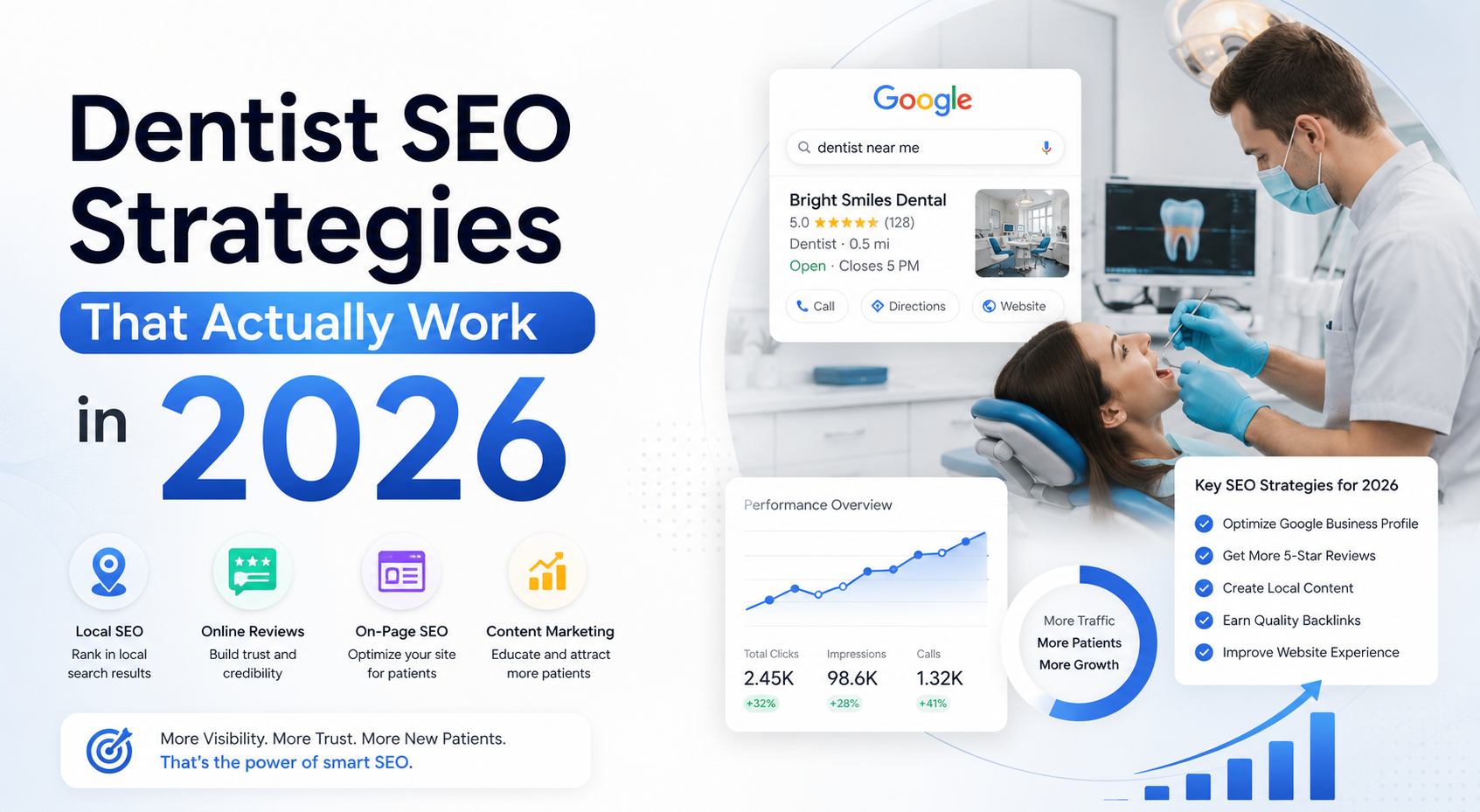
Most dental practices that come to us with a ‘traffic problem’ don’t actually have a traffic problem. They have a prioritization problem disguised as a flat impressions graph. They’ve been told to publish more blogs, claim a few directories, and wait. When nothing measurable changes after six months, they assume dentist SEO strategies don’t work. The data tells a different story.
Dental SEO refers to the set of techniques that improve a dental practice’s visibility in organic search and local map results: Google Business Profile (GBP) optimization, NAP citation building, on-page service-page architecture, technical health, and link authority. When implemented in the right sequence, organic search consistently delivers a lower cost per patient acquisition than paid ads, and compounds over time in a way ad spend never does.
This guide covers the specific dentist SEO strategies that are producing measurable results in 2026, along with the sequencing mistakes that waste budget without moving rankings.
What Is Dental SEO and Why Does It Matter?
Dental SEO is the practice of optimizing a dental website and its surrounding online presence so that Google surfaces it when patients search for relevant services in their area. Searches like ‘dentist near me,’ ’emergency dental care in [city],’ or ‘teeth whitening [neighborhood].’ These are high-intent, location-bound queries from people who are ready to book an appointment. Showing up in those results is the output dental SEO is built around.
The scale of the opportunity is concrete. According to Semrush, the phrase ‘dentist near me’ alone generates 800,000+ monthly searches in the US. With 60+ dentists per 100,000 people in the US market (ADA Health Policy Institute), the practices that rank in the Local 3-Pack capture a disproportionate share of new patient demand. The ones that don’t appear there are effectively invisible to anyone who doesn’t already know their name.
The economics also hold up clearly. Unlike Google Ads, which require continuous spend to maintain any visibility at all, a well-optimized dental website and GBP continue attracting patients long after the initial investment. Across our dental clients, we’ve seen organic SEO deliver 60-70% lower cost-per-acquisition than paid search over a rolling 12-month window, once the rankings compound.
How to Rank a Dental Practice on Google: The Core Pillars
Ranking a dental practice requires coordinated work across five pillars: local SEO and GBP, review strategy, NAP and citation consistency, on-page architecture, and technical health. The sequencing matters. Most practices underinvest in local presence and over-invest in content volume. That is exactly backwards given where the majority of dental search traffic actually comes from.
Pillar 1: Google Business Profile Optimization
GBP is the single most important digital asset for a dental practice. It drives the Local 3-Pack, the map-based results that appear above organic listings for ‘near me’ and city-specific queries. According to Google’s own data, 86% of GBP views come from category-based searches rather than branded name searches, which means a patient’s first contact with your practice often happens on the GBP before they ever reach your website.
A fully optimized dental GBP requires:
- Primary category: set to ‘Dentist,’ with all relevant secondary categories added : ‘Pediatric Dentist,’ ‘Cosmetic Dentist,’ ‘Emergency Dental Service’ where applicable.
- Services listed in detail: Google matches your profile against patient queries using the services section; every procedure you offer should be listed.
- Business hours kept current: including holiday exceptions. An outdated hours listing is a fast route to low-star reviews.
- High-quality practice photos: waiting room, treatment rooms, team photos, updated regularly.
- Q&A section seeded proactively: answer common front-desk questions like ‘Do you accept Delta Dental?’ and ‘Do you offer CareCredit financing?’ before patients have to ask.
- Google Posts published consistently: weekly posts signal an active practice and are crawlable by Google.
The most underused GBP lever we see across dental clients is the Q&A section. Seeding it with answers to the questions your front desk handles 20 times a day accomplishes two things: it helps patients convert faster, and it feeds Google structured information about your practice’s services that the algorithm uses for query matching.
Pillar 2: Review Strategy
Reviews are both a trust signal and a direct local ranking factor. Google’s local algorithm factors in review count, average rating, and recency as inputs. Recency is the variable most practices underweight: reviews from the past 90 days carry more algorithmic weight than older ones, and practices that respond to all reviews, including negative ones, outperform those that don’t in local rankings.
The friction that prevents most practices from executing a consistent review strategy is behavioral, not technical. Clients don’t want to ask patients for reviews because it feels awkward. The fix is an automated system: a review request sent via SMS within 24 hours of an appointment, with a direct link to the GBP review form. We’ve seen practices grow from under 50 reviews to 200+ within a single quarter using this approach.
A case study from a Los Angeles dental clinic illustrates the compounding effect. After combining structured review collection with citation building and local schema implementation, the practice achieved top 3 rankings for ’emergency dentist in Los Angeles’ and ‘teeth whitening Los Angeles’ by month nine, generating a 35% increase in booked appointments (Linkgraph, 2025). The review strategy was one of three inputs; none of the three alone would have produced the same outcome.
Pillar 3: NAP Consistency and Citation Building
NAP (Name, Address, Phone Number) consistency across local directories is foundational. When Google finds your practice listed differently across Yelp, Healthgrades, Zocdoc, Vitals, and the ADA directory, it reduces confidence in your location data and suppresses your local rankings as a result. The inconsistencies are usually small: a suite number written as ‘Ste 4’ in one place and ‘#4’ in another, an old phone number that wasn’t updated after a line change, a practice name with or without ‘LLC’ appended.
The audit we run for new dental clients typically surfaces 20-30 of these inconsistencies across major directories. Each one is a small trust penalty that accumulates. Cleaning them up is unglamorous, but it’s the technical debt that has to be cleared before any other tactics can compound. Priority directories for dental practices:
- Primary: Google Business Profile, Yelp, Healthgrades, Zocdoc, Vitals.
- Secondary: ADA Find-a-Dentist, WebMD Physician Directory, Bing Places, Apple Maps.
- Local: Chamber of Commerce listings, local health directories, regional dental association pages.
Pillar 4: On-Page SEO Architecture
On-page optimization for dental practices follows one clear architectural principle: every service gets its own dedicated page. A single ‘Services’ page covering general dentistry, cosmetic dentistry, orthodontics, and implants cannot rank competitively for any of those terms. Dedicated pages allow topical depth. A page titled ‘Dental Implants in [City]’ can carry the keyword in the title tag, H1, meta description, URL slug, and body copy without cannibalizing other service pages or diluting relevance signals.
The on-page elements that carry real weight:
- Title tag: primary keyword near the front, under 60 characters: ‘Dental Implants in Chicago | [Practice Name].’
- Meta description: 150-160 characters, keyword included, clear patient benefit.
- H1 and H2 structure: H1 for the service-plus-location combination, H2s for sub-topics targeting PAA questions.
- URL slug: short and keyword-rich: /dental-implants-chicago, not /services/page?id=4.
- Content covering the full intent journey: informational (‘what causes tooth sensitivity’), transactional (‘cost of dental implants’), and local (‘best dentist in [city]’).
Schema markup is a high-value step that the majority of dental practices skip. Implementing LocalBusiness schema with NAP data, Dentist schema type, Services schema, and FAQPage schema on FAQ sections helps Google, AI Overviews, and Perplexity cite your pages accurately. According to Birdeye (2026), practices implementing Organization, LocalBusiness, Service, and FAQ schema see measurably stronger AI Overview pickup than those relying on unstructured content.
Pillar 5: Technical SEO
Technical SEO accounts for roughly 40% of the work that actually moves rankings for dental websites, but it’s also the prerequisite work, not the optional layer. If a site has indexing or crawling issues, content and link-building will not compensate. The technical priorities we address first, in order:
- Indexing and crawlability: confirm all key pages are indexed in Google Search Console; resolve any crawl blocks or noindex tags on service pages.
- Core Web Vitals: LCP (Largest Contentful Paint) under 2.5 seconds, CLS (Cumulative Layout Shift) under 0.1. Failing these is a ranking headwind, especially on mobile.
- Mobile-first rendering: over 77% of dental search queries come from mobile devices (industry data, 2026), so mobile UX is what Google indexes first.
- HTTPS: SSL certificate in place. Non-HTTPS dental sites are flagged by browsers and carry a ranking penalty.
- Internal linking: service pages interlinked logically, with homepage and location pages passing authority to deeper service pages.
Technical work we’d quietly deprioritize when budget is limited: exhaustive hreflang implementation for a single-location practice with no international patient base, and full removal of all 4xx links from internal anchor text. Both show up on standard audits, but neither moves local dental rankings in a meaningful way.
What Is Local SEO for Dentists?
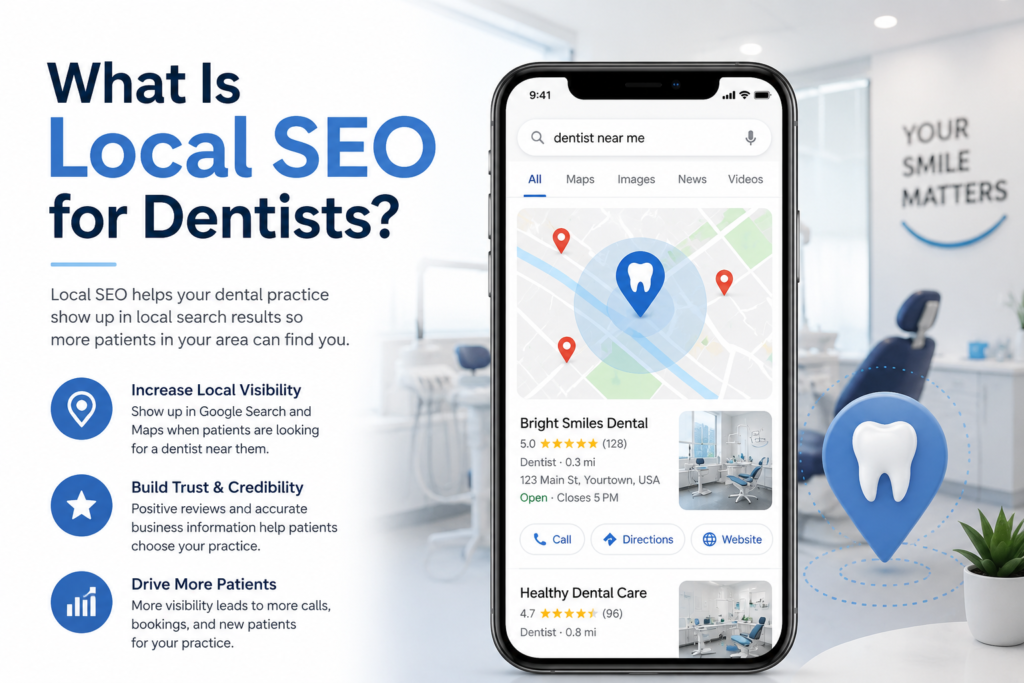
Local SEO for dentists is the subset of SEO focused specifically on ranking in location-based search results: the Local 3-Pack, Google Maps, and ‘near me’ queries. The ranking inputs Google uses for local results differ from those that drive organic rankings: proximity, relevance, and prominence replace domain authority and link count as the primary levers.
The practices that win at local dental SEO in 2026 are not necessarily the ones with the most content or the most backlinks. They’re the ones with the most complete and consistent local presence: a verified GBP with full completeness, strong review velocity, clean citations, local schema, and location-specific service pages. Getting these five elements in order before investing in content volume is the correct sequencing, not the reverse.
How Do You Optimize a Google Business Profile as a Dentist?
GBP optimization follows a two-phase framework: completeness first, sustained activity second. Start with completeness: every field filled, primary and secondary categories accurate, services listed in detail, photos uploaded. Then shift to activity: weekly Google Posts, regular photo updates, prompt responses to all reviews, and proactive Q&A management.
One tactical detail most practices miss: use the GBP ‘Services’ section to list every procedure offered, not just headline services. ‘Invisalign,’ ‘root canal,’ ‘teeth whitening,’ ‘pediatric dentistry,’ ’emergency dental care.’ Each one is an additional query match surface. Google uses these service listings to match your profile against patient searches that your website might not be ranking for yet.
The Q&A section deserves a dedicated 20 minutes when setting up or auditing a GBP. Seed it with the questions your front desk answers on repeat: insurance questions, financing options, appointment availability, parking. Proactively answering these builds patient confidence and reduces the friction between finding your practice and calling to book.
Are Reviews Important for Dental SEO?
Yes. Reviews are a direct local ranking signal and a conversion driver running in parallel. Google’s local algorithm incorporates review count, average rating, and recency as ranking inputs. A practice with 30 reviews from the past six months will outrank a competitor with 300 reviews from four years ago, all else being equal.
The conversion side is equally direct. According to industry data (2026), 74% of patients use online reviews as their first step when evaluating a new dental provider. That means your review profile is often doing more sales work than your website is. Treating it as a passive asset, hoping patients leave reviews without being asked, is leaving a meaningful ranking and conversion lever unmanaged.
How Long Does Dental SEO Take to Show Results?
Organic dental SEO typically takes 4 to 6 months before measurable ranking and traffic improvements appear. Practices starting with significant technical issues, low domain authority, or little existing online presence require longer to build competitive footing. Local map pack rankings tend to improve earlier, sometimes within 60 to 90 days of GBP optimization and review collection, because the local algorithm responds faster to activity signals than the organic algorithm does.
The realistic timeline we set with dental clients:
- Months 1-2: technical fixes, GBP optimization, citation cleanup, schema implementation.
- Months 2-3: first local 3-Pack movement on lower-competition queries; review velocity increasing.
- Months 4-6: organic rankings emerging for service-plus-location keywords; measurable traffic increase.
- Months 6-12: compounding effects across multiple service pages, sustained review growth, Local 3-Pack for high-value queries.
What Link-Building Tactics Actually Work for Dental Practices?
Backlinks remain a meaningful domain authority signal, but the quality hierarchy for dental link-building is specific. These are the four tactics in force-ranked order, from highest to lowest ROI:
- Entity building: getting your practice consistently named and described across authoritative web properties: dental association directories, local news, health publications. This is the foundation that makes every other signal more coherent.
- Digital PR: press coverage of community-facing initiatives generates real editorial links. Free dental check-up camps, school dental awareness programs, new service launches, and local health partnerships are the types of activity that produce linkable coverage.
- Journalist query links: responding to healthcare journalist queries via platforms like Cision (which absorbed HARO) earns citations in published articles. These are high-authority, editorially earned placements.
- Guest posts: ranked last because link quality from guest post placements has degraded significantly in the past 18 months. Still worth doing with careful placement selection, but not the priority.
Link exchanges and paid link placements are not tactics we recommend. Google has become measurably better at identifying and discounting them, and the risk-to-reward ratio has shifted. The more important point is that for most dental practices, the link gap is not the primary bottleneck. Local presence and technical health are.
How Should Dental Practices Handle AI-Driven Search in 2026?
Informational dental queries are increasingly answered directly by Google AI Overviews, ChatGPT Search, and Perplexity without routing clicks to websites at all. Searches like ‘how often should I floss’ or ‘what causes tooth sensitivity’ are being resolved at the SERP level. For transactional queries like ‘dental implants near me’ or ‘book dentist appointment [city],’ Google Maps and organic results remain the primary channel.
The strategic implication is not to abandon informational content, but to structure it so AI engines cite it rather than ignore it. The structural requirements for AI citability:
- Question-format headings: ‘How do dental implants work?’ rather than ‘About Dental Implants.’
- Direct-answer blocks: 40-80 word answers immediately after each question heading, self-contained enough to stand alone.
- Inline data attribution: every claim backed with a source inline, not just a bibliography at the bottom.
- FAQPage schema: implemented on all FAQ sections. This has the highest AI Overview pickup rate of any schema type for dental content.
The content mix that makes sense for dental practices in 2026 is heavier weighting toward transactional and local content, with informational content built for AI citability. Publishing informational content optimized purely for traditional organic clicks is increasingly a diminishing-returns strategy for a niche where transactional intent is where the patient acquisition actually happens.
What the Data Actually Shows
Based on the real data we have seen across dental clients, the practices that win at SEO in 2026 are not the ones publishing the most content. They’re the ones with the most complete local presence, the cleanest technical foundation, and the most systematic approach to review collection. The sequence is what separates practices that see compounding results from those that stay flat despite consistent publishing: local first, technical second, content and authority third.
If you’re seeing flat traffic despite consistent publishing, the question to investigate first is whether you have a content problem, a local SEO problem, a technical problem, or a conversion problem. Each of those diagnoses lead to completely different actions. Have you audited your GBP completeness and NAP consistency recently? Feel free to share what you’re seeing.
FAQs
Dental SEO services typically range from $1,500 to $5,000 per month for a comprehensive agency strategy, with project-based work ranging from $5,000 to $30,000 depending on scope. The right investment depends on your market’s competition level. A solo practice in a mid-sized city requires a fundamentally different budget than a multi-location group practice competing in a top-10 US market.
GBP optimization, review collection, and citation cleanup can be managed in-house with consistency and a few hours per week. Technical SEO, schema implementation, and link-building typically benefit from specialist support in competitive markets. The self-managed approach works when the market is not highly competitive and the practice can commit to executing the fundamentals without interruption.
A dental keyword strategy should cover three intent layers: informational (‘what causes gum recession’), transactional (‘cost of dental implants in [city]’), and local (’emergency dentist near me’). Long-tail procedure-plus-location combinations like ‘affordable family dentist in [neighborhood]’ often convert better than broad terms because they capture patients further along the decision journey, closer to the point of booking.
Blogging improves dental rankings when the technical and local foundations are already in place and the content targets real patient questions with enough depth and structure to rank. The sequencing mistake we see most often: practices publishing 20 blog posts per month before their GBP is complete, before service pages have dedicated URLs, and before citation data is clean. Content volume is not the bottleneck for most dental practices. Local presence and technical health are.
NAP stands for Name, Address, Phone Number. Consistent NAP data across all online directories is a foundational local ranking signal. When Google finds conflicting information about a practice’s location or contact details across the web, it reduces confidence in the location data and can suppress Local 3-Pack rankings. Auditing and correcting NAP inconsistencies is typically the first technical action we take with new dental clients, because nothing else compounds cleanly until this is resolved.
Schema markup, specifically LocalBusiness, Dentist type, FAQPage, and Service schema, helps search engines and AI systems understand exactly what a practice offers, where it is located, and what patient questions it answers. FAQPage schema has a particularly high pickup rate in Google’s AI-powered features and Perplexity citations. Practices with correct schema implementation are more likely to appear in AI Overviews than those relying on unstructured content, even when the underlying content quality is comparable.

Pooja Garg
Pooja Garg is the founder of Sky Storm Digital, a creative digital marketing agency dedicated to helping brands grow through strategy, storytelling, and design. With a passion for blending creativity and data-driven insight, Pooja writes about digital marketing trends, brand building, and the ever-evolving online landscape.
When she’s not crafting campaigns, she’s exploring new ways to connect creativity with technology.