Google started rolling out the September 2026 spam update at 9:15 a.m. Pacific on September 24 (9:45 p.m. in India), and its Search Status Dashboard says the rollout can take up to two weeks. If your Search Console graph dipped any time after that evening, the Google September 2026 spam update is the first suspect, though it is rarely the only one worth checking. A date-filtered comparison in Search Console will tell you which kind of drop you are dealing with, and the five audits further down are the ones we would run on any Indian site this week.
Key takeaways
- Launch date: the update began on September 24, 2026, with a rollout window of up to two weeks.
- Slowest of the year: it is the fourth spam update of 2026, and the earlier three each finished in under three days.
- No named target: Google listed no new tactic, so every existing spam policy is in play.
- Indian risk areas: coupon folders on news portals, AI-scaled city pages, expired domains and bulk guest posts.
- Recovery: Google talks in months, and value from devalued spam links does not return.
What is the Google September 2026 spam update?
The September 2026 spam update is a global change to Google’s automated spam detection, covering every language, that began on September 24, 2026. Google’s notice on the Search Status Dashboard says the rollout “may take up to two weeks to complete” (Google Search Status Dashboard), so the full effect should be visible around October 8. Google named no new tactic. Any site breaking its existing spam policies is exposed.
SpamBrain, Google’s AI-based spam-prevention system, does most of that detection, and a spam update is the moment a retrained or extended version of it goes live across the index. The timing this round stands out. Search Engine Journal’s rollout tracking (Search Engine Journal) shows each earlier 2026 spam update wrapping up in under three days:
| Spam update | Rollout time | Status |
|---|---|---|
| March 2026 | 19 hours, 30 minutes | Complete |
| June 2026 | 2 days, 1 hour | Complete |
| August 2026 | 2 days, 16 hours | Complete |
| September 2026 | Up to 2 weeks | Rolling out (as of October 4) |
Our read is that a two-week window points to a staged release, and reports from the field fit that. Glenn Gabe tracks Google updates closely, and on October 1 he wrote that several site owners had emailed him about sharp drops landing on September 30 (Glenn Gabe on X), almost a week after launch.
So a site that looked fine on September 26 can still get hit.
How exposed are Indian sites to this update?
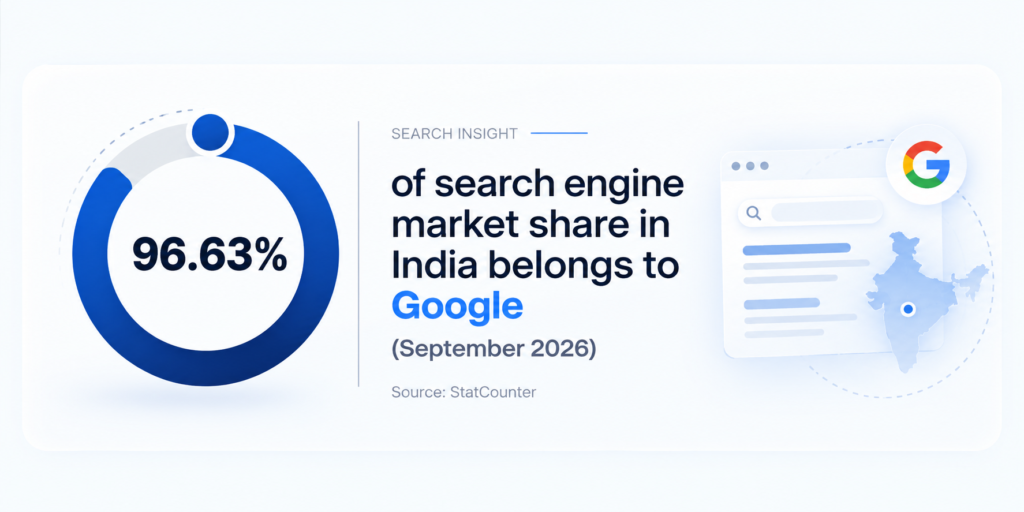
More exposed than most, because Google’s reach in India is close to total. StatCounter’s September 2026 figures put Google at 96.63% of search engine market share in India (StatCounter), so for most Indian businesses a visibility drop on Google is a visibility drop in search, with no Bing traffic to cushion it.
India’s search audience keeps growing too. The IAMAI report published in January 2026 counted 958 million active internet users in India, with rural users making up over 57% of them (IAMAI, via Tele.net). A lot of that new demand searches in Hindi, Marathi, Tamil and other Indian languages, and regional-language results are where template-built pages have the easiest time slipping into the top ten.
Indian publishing also has a couple of habits that sit uncomfortably close to Google’s policy lines: news portals renting out subfolders to coupon and betting operators, and agencies selling “DA 50+ guest posts” by the bundle. Template city pages come a close third (“best CA in Jaipur”, “best CA in Kota”, and on down the list of districts). Nobody invented these in 2026. The September update is one more pass of systems built to find them, running for longer than usual.
How do you know if the spam update hit your site?
Compare your Google Search Console clicks and impressions for September 10 to 23 against September 24 onward, page by page. A spam-related hit usually looks like a sharp, step-shaped drop that starts on a rollout date and covers a whole folder or the whole site, with no matching crawl errors or server trouble. A slow slide, or a drop limited to a handful of URLs, points somewhere else.
Work through the diagnosis in this order, because each step rules out a cause that would make the next one misleading:
- Rule out a manual action first. In Search Console, open Security & Manual Actions and then Manual actions. A manual action comes from a human reviewer with a written reason, while an algorithmic spam demotion never appears in that report.
- Check the technical basics. Look at the Pages report and Crawl stats for spikes in 5xx errors, stray noindex tags or robots.txt blocks around September 24; our technical SEO audit guide has the full list.
- Pin down the date. Switch the Performance report to a daily view. A fall that begins on September 24, 25 or 30 lines up with the rollout.
- Map the shape of the drop. Filter by page and by folder, since a loss sitting entirely inside /coupons/ or /hi/blog/ tells you which practice Google objected to.
- List your own changes. Write down every migration, plugin update, hosting move or CDN switch from the past month with its date, before blaming Google for any of it.
One caveat from doing this many times. Search Console data runs a couple of days behind, and if a core update lands inside the same window the two effects blur together. Wait until the dashboard marks the incident complete before calling it, and keep both comparison windows the same length (14 days against 14 days) so a weekend dip or a Navratri sale week doesn’t skew the read.
Five checks Indian site owners should run now
Google gave no target list for this update. We audit against the policies Indian sites break most often, starting with whichever section carries the most organic traffic.
| Google spam policy | Common Indian pattern | First check |
|---|---|---|
| Scaled content abuse | AI or template pages for every city and service | Zero-click pages with near-identical structure |
| Site reputation abuse | Coupon or betting folders on news portals | Partner-run subfolders and subdomains |
| Expired domain abuse | Old .in domains redirected into money sites | Domains bought in the last two years |
| Link spam | Bulk guest-post packages | Referring domains from one vendor or month |
| Hacked content and UGC spam | Injected casino and pharmacy pages on WordPress | site: searches for spam terms |
1. Scaled content abuse in AI-written and template pages
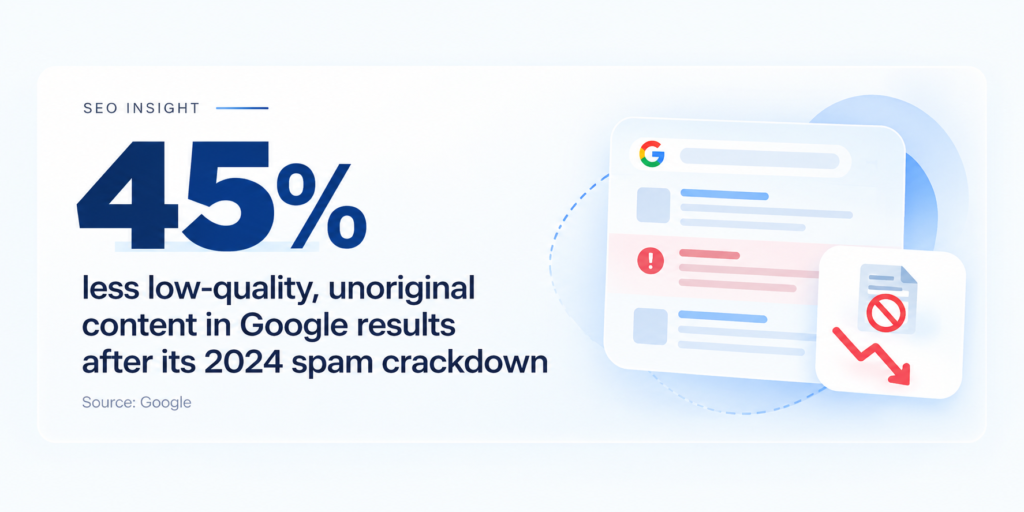
Google’s scaled content abuse policy covers “many pages generated for the primary purpose of manipulating search rankings and not helping users”, whether a person or a model wrote them. When Google introduced it during the March 2024 crackdown, it later reported 45% less low-quality, unoriginal content in search results, beating the 40% it had expected (Google).
Pull every URL published since January 2025 into a spreadsheet (a Screaming Frog crawl or a sitemap export both work) and sort by word count and organic clicks. Start with pages that share one template and have earned zero clicks in six months; those are the first to merge, rewrite or noindex. Translations count as well; a Hindi version of an English post, machine-translated with no local examples, reads as scale to Google, and our 2026 on-page SEO checklist covers what a rewritten page should carry instead.
2. Site reputation abuse on news and media portals
This policy targets third-party content published on an established site mainly to borrow that site’s ranking signals. In India the textbook case is a news portal hosting a coupon section or a fantasy-cricket tips folder that the newsroom never touches.
If you run a publication, list every subfolder or subdomain a partner operates. Bring each one under real editorial control or move it off the main domain, and noindex it in the meantime if you can’t decide this week.
3. Expired domains and redirected networks
Buying an expired domain for its old backlinks and filling it with fresh affiliate or casino content falls under Google’s expired domain abuse policy. A quieter Indian variant buys an old .in domain with decent links and 301-redirects it into a money site. Check Ahrefs or Semrush for referring domains whose topic or ownership changed recently, and audit any domain your business picked up in the last two years with that history in mind.
4. Paid guest posts and link schemes
Link spam covers links created mainly to manipulate rankings. If most of your referring domains arrived from one vendor or within one month, treat that as a red flag, and expect those links to count for nothing once SpamBrain spots the pattern.
We would rather see ten editorial mentions than three hundred placed posts, and our link building service is built around that ratio. Mentions in trade press and local news hold up through updates far better than a marketplace order sheet does.
5. Hacked pages, user spam and thin affiliate pages
Run site: searches on your own domain for Japanese characters, “casino”, “satta” and pharmacy terms. WordPress installs with outdated plugins are frequent targets for injected pages that never appear in the admin panel, and open comment sections or profile pages collect spam the same way, so set user links to nofollow and moderate new accounts.
Affiliate sites need one extra pass. Google’s thin affiliation policy flags pages that copy product descriptions next to affiliate links without adding anything, so give every roundup something only you can supply, such as your own usage notes or photos from actual testing.
What should you avoid while the rollout is live?
Hold off on big structural changes until Google marks the update complete. Rewriting 300 pages or moving to a new domain mid-rollout makes it impossible to tell what caused what, and a domain move can even resemble the expired-domain pattern Google is hunting. Small fixes are fine, such as removing hacked pages or noindexing an obvious coupon folder.
Skip the disavow file too, unless you received a manual action for unnatural links or knowingly bought links at scale. An aggressive disavow can strip out links that were helping you.
How long does recovery from a spam update take?
Expect months. Google’s spam update documentation says sites that fix violations may improve once its systems learn “over a period of months” that the site complies (Google Search Central). There is no reconsideration request for an algorithmic demotion and no fixed date for a bounce back.
Link spam is the exception you can’t fix your way out of. Google states that when its systems remove the effect of spammy links, any ranking benefit those links produced is lost, so recovery means earning new links and mentions from sites that would cite you anyway; we explain in our piece on why brand mentions now rival backlinks where that effort pays off.
Our default play here is a 90-day plan. Clean up in the two weeks after the rollout ends, publish fewer but stronger pages over the next two months, and then compare Search Console data quarter on quarter. If nothing has moved by the next core update, the problem is usually broader content quality, and that calls for a different audit.
Where to start this week
The September 2026 spam update enforces Google’s existing spam rules over a longer window than any spam update this year. For an Indian site the biggest risks sit in coupon folders and bought links, with template city pages close behind, so start there. Export your Search Console Performance data for September 10 to 23 and for September 24 to October 8, compare clicks folder by folder, and run the five checks above on whichever folder fell furthest. Send that comparison to our team with your domain, and we will tell you which check to run first.
FAQ
Frequently asked questions
It started on September 24, 2026 at 9:15 a.m. Pacific, or 9:45 p.m. in India. Google said the rollout could take up to two weeks, so we expect it to close out around October 8, give or take a day.
Only indirectly. Google named no specific target, and its scaled content abuse policy applies whether a person or a model wrote the page. The AI pages that get into trouble are usually published by the hundred, with nobody editing them and no named author behind them. An AI-assisted article that an expert has checked and added to is judged like any other page.
Yes, though slowly. Google says sites that fix policy violations may improve once its automated systems learn, over a period of months, that the site now complies. Remove or rewrite the pages that broke a policy and stop any paid link buying; hacked or user-generated spam needs clearing out as well. After that, give it at least one full quarter before judging the result, because one week of Search Console data will mislead you. Links that Google has already devalued will not come back, so new links have to be earned. If you want a second opinion first, our free SEO audit flags the policy risks on your domain.
A spam update targets sites that break Google’s spam policies, while a core update reassesses overall content quality and relevance across the index. The two can overlap in time. A spam hit tends to be sharp and tied to a specific practice; a core update drop usually spreads across many page types (and, frustratingly, is harder to pin on one cause).
If the posts are bought mainly for the link, yes. Google’s link spam policy covers links created to manipulate rankings, and bulk packages fit that description closely. Sponsored placements are fine when the link carries rel=”sponsored” and the article reaches a real audience.

Pooja Garg
Pooja Garg is the founder of Sky Storm Digital, a creative digital marketing agency dedicated to helping brands grow through strategy, storytelling, and design. With a passion for blending creativity and data-driven insight, Pooja writes about digital marketing trends, brand building, and the ever-evolving online landscape.
When she’s not crafting campaigns, she’s exploring new ways to connect creativity with technology.