Two sites publish equally good guides on GST registration. One has links from the Economic Times and a couple of CA blogs pointing at it; the other has none. Guess which one ranks. Backlinks still settle a lot of these ties in 2026, and this guide covers which ones count and how to earn them without buying anything you’ll regret later, with numbers from Ahrefs and Google’s own documentation.
Key takeaways
- A backlink is a link from another site to yours, and Google still reads good ones as a vote of trust.
- Relevance beats raw authority. A local news link can outweigh a DR 70 site that has nothing to do with you.
- Paid links need rel=”sponsored” or rel=”nofollow” or Google treats them as link spam.
- Earn links with things worth citing, like original data, a free tool or an expert quote.
- Check your profile monthly in Search Console’s Links report, which costs nothing.
What is a backlink?
A link on someone else’s website that points to yours. If a Jaipur food blogger links to your restaurant’s menu page, that’s a backlink for you (and an outbound link for them).
Links between pages on your own site are internal links, a separate topic that we cover properly in our guide to internal linking for SEO. Backlinks come from outside. Google reads them, roughly, as other people vouching for you.
Do backlinks still matter for SEO in 2026?
Yes, quite a lot. Ahrefs’ 2023 study of about 14 billion pages found 96.55% of them get no traffic from Google at all, and of the roughly 20 million pages with no referring domains, only 2,997 cleared 1,000 monthly search visits.
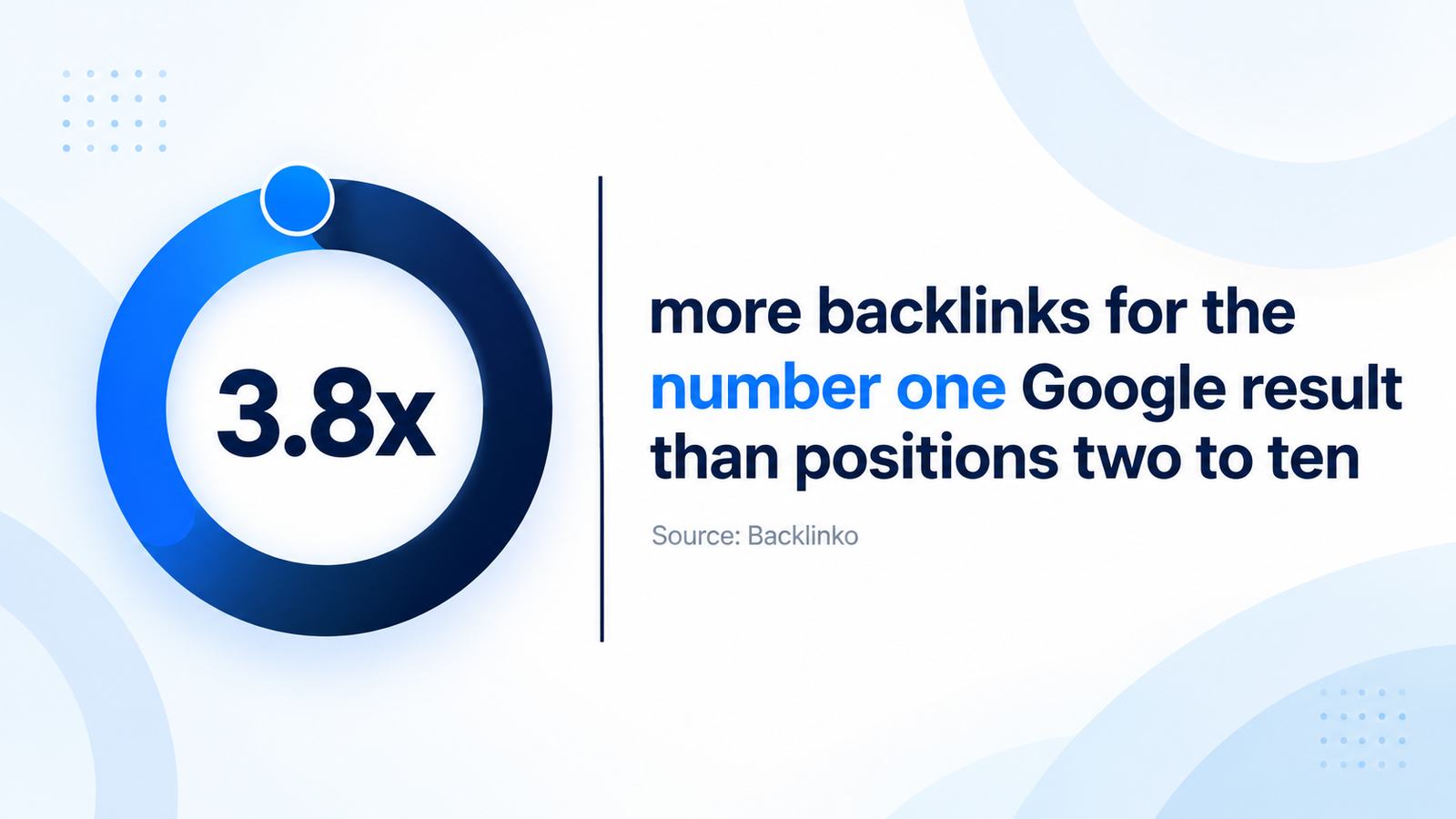
Backlinko’s ranking analysis of 11.8 million Google results points the same way, with the number one result averaging 3.8 times more backlinks than positions two to ten. It’s an older dataset (refreshed in 2025, though most charts date from 2020), so treat it as a direction more than a rule.
Links feed AI search too. ChatGPT and Google’s AI Overviews tend to quote pages that already rank and get cited elsewhere, so a site nobody links to struggles to show up in either place, something we run into constantly in our GEO work.
What kinds of backlinks are there?
| Type | What it tells Google | Passes ranking value? |
|---|---|---|
| Followed (no attribute) | A normal editorial link | Yes |
| rel=”nofollow” | Don’t associate us with this page | Usually not; treated as a hint |
| rel=”sponsored” | Paid or affiliate link | Usually not |
| rel=”ugc” | Comments and forum posts | Usually not |
Nofollow links still have a use. They send referral visitors, and a profile with none of them at all looks a little odd, though we’d never chase them on purpose.
What makes a backlink good or bad?
Relevance first, then whether real people read the page the link sits on.
- Topic match. A link from a Jaipur tourism blog helps a hotel far more than one from a crypto news site with a higher DR.
- Real traffic. Check the linking site’s organic traffic in Ahrefs or Semrush. A DR 60 site with almost no visitors has usually been inflated.
- Editorial placement. Inside an article, written by someone who chose to link. Footer and sidebar links count for much less.
- Natural anchor text. Mostly your brand name or a plain URL, with keyword-stuffed anchors kept rare.
Bad links look like the opposite. Paid links without a rel attribute appear in Google’s own link spam examples, and so do low-quality directory links and footer links spread across hundreds of templates. A ₹4,999 package of 500 backlinks usually contains plenty of both.
How do you earn backlinks without buying them?
By giving other sites a reason to link. Six methods do most of the work for our clients, easiest first, roughly.
- Unlinked mentions. Find pages that mention your brand without linking, through a plain Google search or Ahrefs Content Explorer, and ask the editor to add one. The easiest wins here.
- Broken link replacement. When a resource page links to something that now returns a 404, offer your page as the replacement. Editors like being told.
- Linkable assets. A GST due-date calendar or a free EMI calculator, say. Other writers cite them without being asked.
- Digital PR and expert quotes. Journalists ask for sources on Qwoted and on HARO, which went quiet in late 2024 until Featured bought and relaunched it in April 2025. One quote in a business publication can beat a dozen guest posts.
- Guest posts on sites your customers read. Fine when the article is good and the anchor is your brand. Keyword-rich anchors in guest posts are one of Google’s named link spam examples.
- Local links. Sponsor a local event or speak at a college, and the coverage usually brings a link or two. For local businesses these often matter more than national ones.
It’s the same list our link building team works through every week.
How many backlinks do you need?
No fixed number. It depends on how many referring domains the pages ranking above you have, and the quickest way to find out is a backlink gap check (the first step in our link building strategies for 2026): put your domain and two competitors into Ahrefs and see which sites link to them but not to you.
For a local business, closing the gap might take twenty decent links, while a national ecommerce brand could need several hundred built over a year or two.
What does link building cost in India?
Expect ₹3,000 to ₹25,000 per quality editorial link, going by IRPR’s 2026 pricing guide, with digital PR placements running higher. Cheaper packages exist. IRPR puts budget packages at ₹25,000 to ₹50,000 a month for three to six mid-authority links, which is a fair benchmark for most Indian small businesses starting out.
How do you check your backlink profile?
| Tool | Best for | Cost |
|---|---|---|
| Google Search Console | Your own links, straight from Google | Free |
| Ahrefs | Competitor gaps and lost links | Paid |
| Semrush | Link audits next to keyword research | Paid |
| Moz Link Explorer | A quick authority snapshot | Free tier |
| Majestic | Trust Flow and link history | Paid |
Which backlink myths should you ignore?
- “Only .edu and .gov links matter.” Any relevant, trusted site helps, and a local newspaper often helps more.
- “All backlinks must be dofollow.” A natural profile has a mix, and nofollow links still bring visitors.
- “Buying links is fine if nobody notices.” Google’s spam systems exist to notice, and a discounted link’s value is gone for good.
- “Link building is dead.” The Ahrefs traffic data above says otherwise.
Where should you start?
Start with half-earned links. Find your unlinked mentions this week. After that, plan one linkable asset for next quarter and check Search Console’s Links report once a month, which takes about twenty minutes once you know where to look. If the whole thing starts to feel like a part-time job, that’s because it more or less is one.

Pooja Garg
Pooja Garg is the founder of Sky Storm Digital, a creative digital marketing agency dedicated to helping brands grow through strategy, storytelling, and design. With a passion for blending creativity and data-driven insight, Pooja writes about digital marketing trends, brand building, and the ever-evolving online landscape.
When she’s not crafting campaigns, she’s exploring new ways to connect creativity with technology.