Key takeaways
- Nobody can guarantee rankings. Google says so in its own guide to hiring an SEO.
- Cold emails and WhatsApp pitches are something Google tells you to be wary of.
- Your domain and Google Business Profile should be in your name, with the agency added as a user.
- Cheap packages built on “1,000 backlinks” are usually link spam, which Google’s policies can demote or remove a site for.
- A good report ties work to enquiries, with Search Console data you can check yourself.
If you run a business in Jaipur you’ve probably had the WhatsApp message already. “Sir, your website is not ranking on Google. We will bring you on first page in 30 days. Package only ₹4,999.” Sometimes with a screenshot of your site and a red cross on it. We get forwarded these by clients every month, and they’re the easy ones to spot. The harder ones come from agencies with nice offices and proper proposals, who still end up owning your Google profile and sending reports full of numbers that don’t mean anything. Some build links that get you in trouble a year later. So here are the warning signs we’d look for, mostly backed by what Google itself says about hiring an SEO. Yes, we’re an SEO company in Jaipur too. Hold us to the same list.
Is a ranking guarantee a red flag?
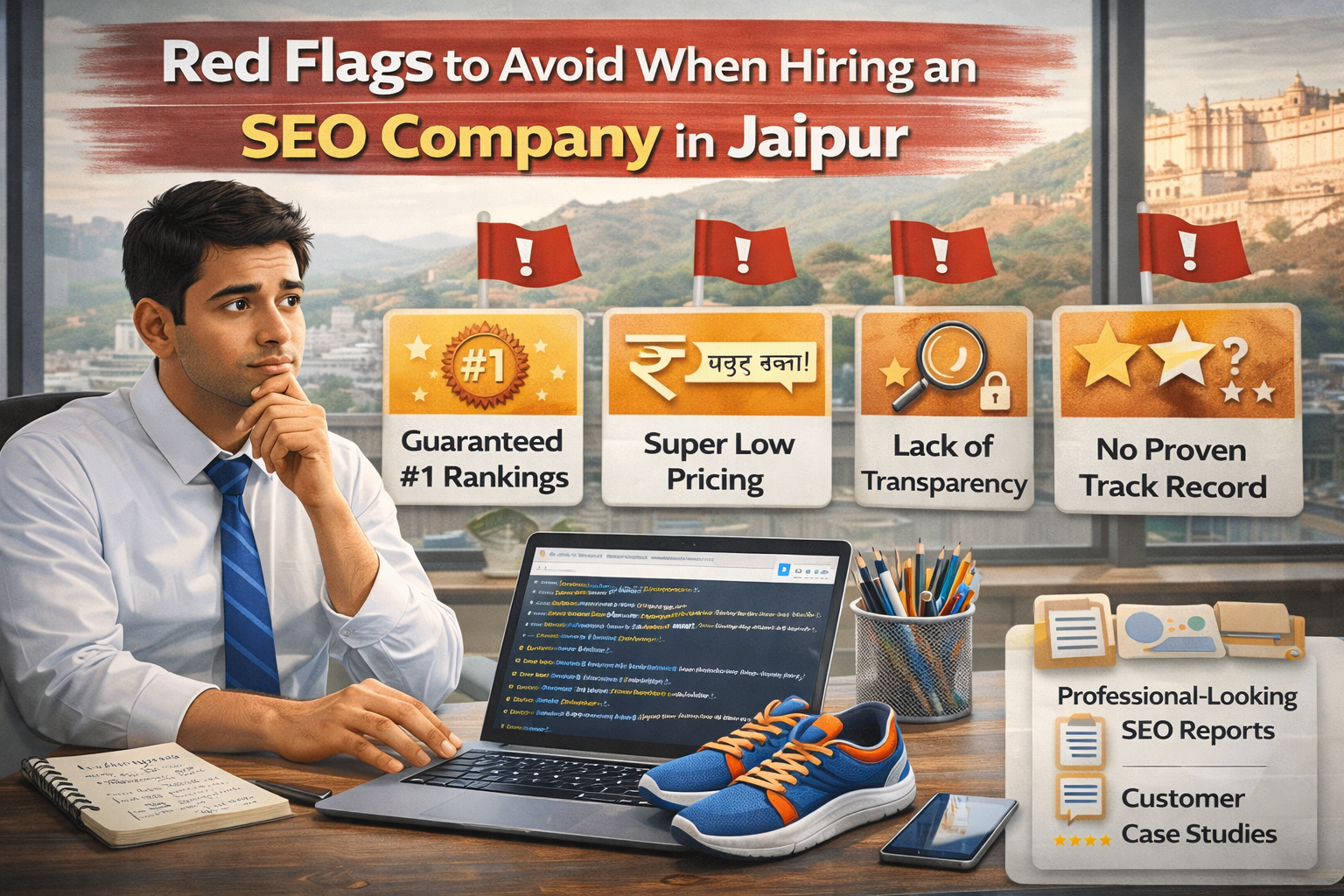
The biggest one. Google’s page on hiring an SEO says it plainly: “No one can guarantee a #1 ranking on Google.” Same page warns against anyone claiming a “special relationship” with Google or offering “priority submit”, which doesn’t exist.
Small print helps some. They’ll guarantee “top 10 for 10 keywords” and then pick ten phrases nobody searches for, like your business name plus “best Jaipur”, so the guarantee gets met and nothing changes in your phone calls. Ask which keywords, and what search volume they have. Then ask what happens if those positions bring in no enquiries. Map pack promises are the same story, since Google’s Business Profile help says there’s no way to request or pay for a better local ranking.
Should you trust an agency that cold-messages you?
Be careful. Google’s same guide says to “be wary of SEO firms and web consultants or agencies that email you out of the blue”, and a WhatsApp forward is just the 2026 version of that email. Good agencies get most of their work through referrals and their own search rankings.
Look at the template. If the message says “your website has 47 SEO errors” without naming one specific page, it was sent to a thousand businesses that morning from a scraped list of Justdial numbers.
What does a very cheap SEO package usually mean?
Usually that the work is automated and the links are bought. A ₹5,000 a month package can’t pay for someone to write useful pages or earn real links, so the hours go into things a tool can do in bulk: directory submissions, comment links, spun articles on free blogs, sometimes a network of sites the agency owns.
Google’s spam policies cover most of that. Buying or selling links for ranking purposes counts as link spam, and Google’s name for mass-producing low-value pages to manipulate rankings is scaled content abuse. Doesn’t matter if a person or an AI tool wrote them. Sites breaking these policies may rank lower or vanish from results. You carry that risk. The agency doesn’t, and Google’s hiring guide adds that you’re responsible for what the companies you hire do on your behalf.
Cheap can be fine, mind you. A freelancer doing honest on-page fixes for a small site at a low monthly rate can be good value, so long as you can see what the hours go on line by line. Ideally none of them involve the word “backlinks” followed by a big number. Our SEO cost guide for India shows what different budgets usually buy in 2026.
Who should own your website and accounts?
You. Every one of them. Domain registration and hosting first, then your Google Business Profile and Search Console. Analytics and any ad accounts too. All of it should sit in your name or your company’s, with the agency added as a user you can remove the day you stop working together.
It happens more than you’d think: a business leaves an agency and finds out their Google profile was created under the agency’s email, with years of reviews attached to it, and getting it back meant weeks of back and forth with Google support. Some agencies also build the site on their own hosting and charge to “release” it. Check before you sign, not after.
Google’s guide gives one more practical rule for the first stage of any engagement: only grant read access to Search Console, not write access, while the agency is still auditing.
What should an SEO report show you?
Business numbers first. Enquiries from organic search come top. Then calls and direction requests from your Business Profile, then clicks to your service pages from Search Console, with rankings underneath all of that for keywords you agreed on together.
Watch for reports padded with impressions graphs, “domain authority” scores from third-party tools, and lists of 200 “backlinks built” with no URLs you can click. Those look busy. A report that never mentions leads or sales in twelve months probably isn’t hiding good news. And if the agency won’t give you direct Search Console access so you can check the numbers yourself, that’s a red flag on its own.
How do you check an agency’s case studies?
Ask for names. Specifically the client’s name and permission to call them, because a real agency will usually have two or three clients happy to take a five-minute call. If every case study is “a leading ecommerce brand” with no name or website attached, and the graph has no axis labels, you’ve learned something.
Also check the agency’s own site. Does it rank for anything in Jaipur, and has its blog been touched this year? An SEO company that can’t get its own pages found is a strange choice to hire for yours. You can see our own named examples, like the wellness brand we migrated off OpenCart, and ask us for references the same way before you sign anything.
What should be in the contract?
Specifics. A list of deliverables with numbers attached and a notice period you can live with. Plus a clause saying every account and every piece of content belongs to you, and no twelve-month lock-in without an exit, especially from an agency you haven’t worked with before.
Three months’ notice on a monthly retainer is about the most we’d accept, and one month is common and perfectly fair for both sides of the deal. Longer than that? Ask why the agency doesn’t trust its own results enough to let you leave.
What should you ask before signing?
Google’s hiring page has a good list. A few of the questions it suggests:
- Can you show me examples of previous work and share some success stories?
- Do you follow Google Search Essentials?
- What results do you expect, in what timeframe, and how do you measure success?
- What’s your experience in my industry and my city?
- Will you share every change you make to my site?
Listen for specifics. “We’ll improve your rankings” is an answer to nothing. For more on comparing agencies side by side, see our guide on how to choose the right SEO agency in India, and if you’d like us to answer the same questions, our SEO team in Jaipur is happy to.
FAQ
FAQs
No. Google says nobody can guarantee a number one ranking, and since nobody controls Google’s results except Google, that’s not going to change any time soon. Agencies offering guarantees are either picking easy keywords nobody searches for or taking risks with your site that you’ll pay for later.
It varies with the size of the site and how competitive your trade is. Be suspicious of anything that sounds too cheap to pay for real writing and real links, and ask exactly what the monthly hours go on.
Tactics that try to trick Google rather than earn rankings. In India the usual suspects are bought links and private blog networks. Mass-produced AI pages too, and Google Business Profile names stuffed with keywords. Short-term gains, sometimes. Then a spam update or manual action lands and rankings drop, and cleaning up ends up costing far more than doing it properly in the first place would have.
First, get a list. Search Console’s Links report shows sites linking to you, and an outside audit can flag the obviously paid or spammy ones. Most low-quality links Google simply ignores these days, so a mass disavow often isn’t needed. It becomes worth considering if you’ve received a manual action for unnatural links, which shows up in Search Console’s Manual actions report, or if you know for certain that someone bought links at scale on your behalf. Don’t panic-delete pages or switch domains either, since that tends to cause more damage than the links themselves. And make sure whoever you hire next can explain, in plain language, what they found and why they’re recommending what they are.
Not with an agency you haven’t worked with yet. Start monthly, or with a short trial on a clearly defined piece of work like an audit or a set of service page rewrites, so you can judge them on something real before committing. Good ones keep clients anyway.
Choose the Right SEO Partner for Your Success
Choosing the right SEO company in Jaipur is crucial for your business’s online success. At Sky Storm Digital, we specialize in ethical, data-driven SEO strategies tailored to your unique needs. Our transparent pricing and proven track record ensure you get the results you deserve. Contact us today for a free consultation and take the first step towards achieving your digital goals.
 Get Your Free Consultation

Pooja Garg
Pooja Garg is the founder of Sky Storm Digital, a creative digital marketing agency dedicated to helping brands grow through strategy, storytelling, and design. With a passion for blending creativity and data-driven insight, Pooja writes about digital marketing trends, brand building, and the ever-evolving online landscape.
When she’s not crafting campaigns, she’s exploring new ways to connect creativity with technology.